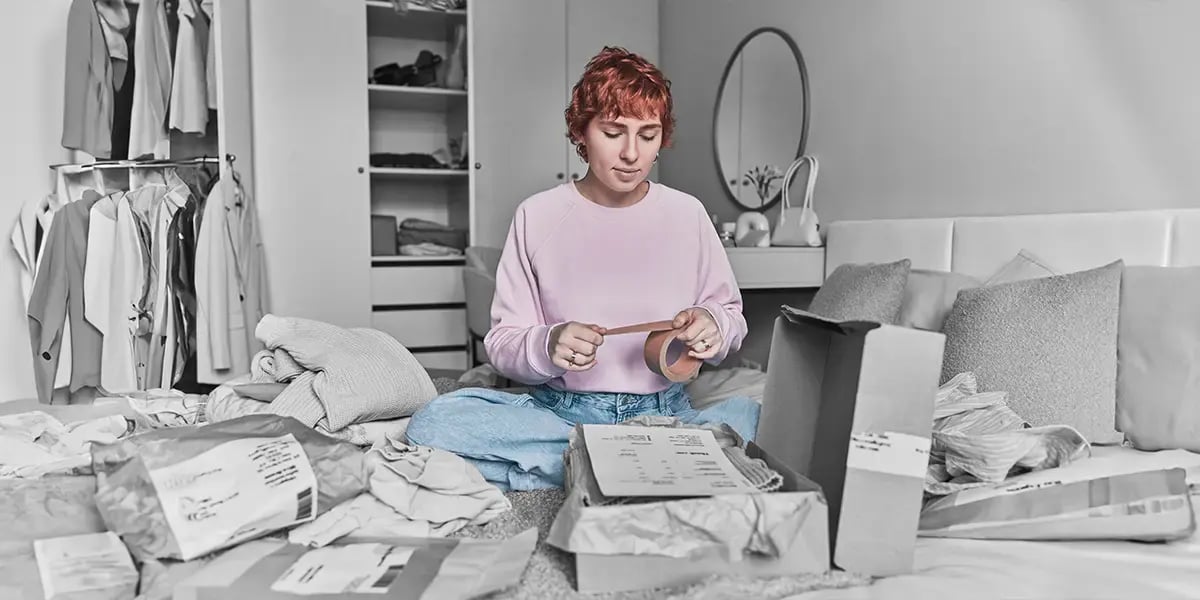
Wardrobing is buying an item, using it once, and returning it for a full refund as if it were unworn. It usually involves clothing, and the same pattern can apply to anything bought for one use, such as a camera, a power tool or party supplies. It is a form of return fraud that retailers catch in the returns process, where the item's condition is recorded.
Wardrobing is often discovered after the refund has gone out: a dress comes back with a faint mark on the hem and "changed my mind" as the reason, and the refund was paid when the carrier scanned the parcel. A retailer that reads its own return reasons can spot the pattern earlier, before the losses build up in the margin.
What does wardrobing mean?
Wardrobing means buying something to use for an occasion and returning it afterward as new. A customer orders a dress for a wedding, a camera for a holiday or a projector for a party, uses it, and sends it back inside the return window with the tags reattached. The refund is claimed on the basis that the item was never used.
The term is most often used for clothing, where an outfit worn once for an event can pass as unworn. The same pattern can apply to any item where one use leaves little visible trace, such as formal shoes, cameras and lenses, power tools, gaming hardware or a tent. Research from the University of Portsmouth and three partner universities, funded by Cifas and published in May 2026, names wardrobing ("where items are worn and returned") among the most common refund-fraud methods it found.
Wardrobing becomes fraud through deception: the customer knows the item was used and presents it as unworn to get a refund the policy does not allow.
Wardrobing, bracketing and serial returning: the difference
Bracketing and serial returning are return abuse: they cost the retailer money and stay within the policy, while wardrobing is fraud. All three appear in the same returns data, and each calls for a different response.
Bracketing is ordering several sizes or colors with the intention of keeping one. The customer returns the rest unworn and within the window, as the policy allows, even though the practice is expensive for the retailer.
Serial returning is when a customer returns a far higher share of orders than the rest of the customer base, order after order, usually within the rules, so retailers handle it through policy and product data.
| Behavior | Is it fraud? | What reduces it |
| Bracketing | No. The policy allows it | Return shipping fees where disclosed, free returns above an order value, better size and fit information |
| Serial returning | No, unless combined with deception | Policy per customer group, return-rate monitoring, fit and product-page fixes |
| Wardrobing | Yes. The item was used and returned as unworn | Condition capture, photo evidence, inspection before refund, the diminished-value deduction |
A condition check passes a bracketing customer's unworn items straight through, and a return fee only nudges the arithmetic for someone who has already worn the dress to the wedding.
Why wardrobing happens and when to watch for it
Retailers made returns easy on purpose. Free returns, long windows and refunds issued at the carrier's scan help win orders, and they also remove the point where anyone inspects the item before the refund is paid.
The Cifas-funded research analyzed nearly 500,000 posts on cybercrime forums, Telegram and Discord where refund-fraud techniques were shared openly. Mike Haley, chief executive of Cifas, called for education to challenge the belief that this behavior is acceptable.
Occasion wear is bought for weddings, summer holidays, graduations and parties, so the weeks around them are a sensible time to tighten inspection.
What wardrobing looks like in your returns data
Returns teams can look for these signs of wardrobing in their returns data:
- SKU return rates far above the category average on occasion wear, formal shoes, cameras, projectors and tools. A dress with twice the return rate of similar items, and no complaints about fit, belongs on the inspection list.
- Returns clustered in the days after public holidays, bank holidays, wedding season, graduation and long weekends.
- "Changed my mind" or "did not fit" on items that arrive with scuffed soles, missing hygiene strips, deodorant marks, perfume, or a tag reattached with the wrong fastener.
- An item ordered a few days before an event and returned a few days after it.
- An account that returns occasion wear after every holiday, or returns far more in one category than in any other.
To check for these signs, use product-level return-rate monitoring to find the most-returned SKUs and see whether each one's rate has risen against the previous 30 days. Export reason and condition codes to a BI tool to find the "worn" and "tags removed" cases and the customers behind them. The warehouse scan at receipt confirms the condition.
Record the item's condition when the customer starts the return.
In nShift Returns, the customer gives a reason and a condition for every item, with a photo on the reasons you choose. See how nShift Returns handles it.
How retailers prevent wardrobing
Each of these controls is part of returns management, and most add no extra step for the customer returning an unworn item within the window. State the ones that do, such as a photo on a specific reason, in the returns policy so the customer knows what to expect.
Ask for the condition as well as the reason
A return request that asks only "why" says nothing about the item's condition. Ask for the condition on every order line as well: unworn with tags, tried on, worn, damaged. Make "worn" and "tags removed" explicit options in the return request. The customer who selects "tried on" has told you what to inspect, and the customer who selects "unworn with tags" on a scuffed pair of shoes has made a claim that the inspection at receipt can test.
Require a photo on the reasons that need one
Set photo upload per return reason: required for the reasons and product categories that attract wardrobing, optional everywhere else. Limit reasons to the categories where they apply, so "too small" appears on clothing and never on a camera. A photo taken at the request, before the label is issued, gives the retailer evidence while the item is still with the customer, and it adds one short step for the honest customer.
Inspect occasion wear at receipt and refund after inspection
For the categories where wardrobing is common, issue the refund once the warehouse has scanned and inspected the item. Consumer law sets the outer limit. In the UK, where the retailer has not offered to collect the goods, a statutory cancellation must be refunded without undue delay and within 14 days of the retailer receiving the goods back or of the customer supplying evidence of sending them, whichever comes first. In the EU, the refund is due without undue delay and within 14 days of the customer's withdrawal notice; unless the retailer has offered to collect the goods, it may hold the refund until the goods arrive or the customer shows evidence of sending, whichever comes first. In both cases the deadline can start before the parcel reaches the warehouse, so check occasion wear as soon as it arrives. A warehouse scan tool that shows item-level data, plus a photo or short video at the returns bench of anything that fails inspection, gives the refund decision a record.
Tighten the window and the fees where the law allows
Set return periods and fees per market and per return flow. Statutory withdrawal rights are the floor and cannot be reduced. Above that floor, a shorter window on occasion wear outside campaign periods, free returns above a minimum order value, and return shipping fees disclosed before purchase each add a cost or a deadline for someone planning to wear and return. Keep the rules separate for each market so a customer in Sweden and a customer in the UK each see a policy that fits local law.
Use the store
An in-store return puts the item in front of a member of staff, who can check it before the refund is issued. Offering the store as a return option at the point of request moves more occasion wear into that channel without a policy change, provided store staff have the order record and a short checklist of what to look for.
Customer story: Hunkemöller
Hunkemöller saw a 15% shift from warehouse to in-store returns
Hunkemöller replaced printed return labels with a digital returns flow in nShift Returns across six European markets.
15%
shift from warehouse returns to in-store returns
6
European markets live on nShift Returns
“Because we’ve added more intelligence to the process, we’re getting much more in the way of consumer touchpoints helping us to constantly improve the service and experience we offer.”Robin Visser, Omni Channel Business Development Manager, Hunkemöller
Keep the controls targeted. A blanket photo requirement on every return adds a step for every customer to catch a few. A fixed blacklist of customers is a data-protection decision and catches honest customers who share an address or a return pattern. And the right of withdrawal cannot be refused outright. For a worn garment, the lawful route is the diminished-value deduction in the next section.
Can you deduct for a worn item? The EU and UK rule
Consumers in the EU and the UK who cancel within the statutory period are entitled to a refund. They are also liable for any loss in value caused by handling the goods beyond what was necessary to establish their nature, characteristics and functioning. The EU directive gives the test in its own recital: the consumer may try on a garment but may not wear it. In the UK, the retailer may deduct that amount from the refund, up to the contract price. In EU countries the directive sets the liability and national law sets how it is recovered; Sweden and Norway both write the duty to compensate into their distance-selling acts.
Two limits apply. The amount must reflect the loss in value, such as cleaning or repair costs or the gap between selling the item as new and as second-hand; the retailer cannot charge for the value of the use the customer had from the item. And the retailer's right to deduct is lost if it failed to inform the customer about the right of withdrawal before the sale; the customer's own withdrawal right survives, and the withdrawal period extends by up to 12 months. Separately, sealed goods that are not suitable for return for health protection or hygiene reasons and were unsealed after delivery fall outside the withdrawal right. The exception applies only where, once unsealed, the goods are definitively no longer saleable for genuine health or hygiene reasons, because their nature makes it impossible or excessively difficult to prepare them for resale, for example by cleaning, and it does not touch the customer's rights if the goods are faulty.
Our article on the right of withdrawal covers what retailers must tell customers before the sale.
Recording the item's condition at the request and photographing it at receipt gives the retailer the evidence to calculate a deduction and defend it if the customer disputes it.
Where nShift Returns comes in
Most of these controls are settings in returns management software. nShift Returns captures reason and condition codes per SKU, with photo upload set per reason and reasons limited to product categories. It applies approval rules for claims and high-value returns, sets return periods and fees per market and flow, and monitors return rates by product with a 30-day trend. At the warehouse, a scan tool shows item-level data and keeps restock status visible.
The guide to choosing returns management software covers what to ask a vendor about reason capture and approvals.
With condition capture, photos on the reasons that need them, inspection before refund on occasion wear and the statutory deduction in place, a worn item returned as unworn is checked at the request, at receipt and before the refund is paid. Talk to a returns specialist about setting these rules for each of your markets.
Frequently asked questions about wardrobing
Is wardrobing illegal?
How common is wardrobing?
What is the difference between wardrobing and bracketing?
How can a retailer tell if an item has been worn?
Can a retailer refuse a wardrobed return?
Should a retailer blacklist customers who wardrobe?

About the author
Jyo Saikia
Product Specialist Director, nShift
With extensive experience in logistics, supply chain, and IT SaaS, Jyo specializes in helping businesses optimize operations and achieve sustained success. His deep industry knowledge enables him to craft innovative strategies that deliver tangible results, ensuring customers gain a competitive edge.