nShift vs Aftership:
Which best fits EU/UK delivery operations?

Comparison covers checkout, shipping, tracking, returns, and emissions for retailers, brands, 3PLs, and marketplaces operating in the EU and the United Kingdom. 


*Cited sources were last verified November 2025. 

Comparison at a glance
nShift vs. AfterShip

nShift vs AfterShip: which fits your delivery operations? 
How we compare: Same-need features; vendor primary pages, and a dated third-party usability snapshot.

nShift

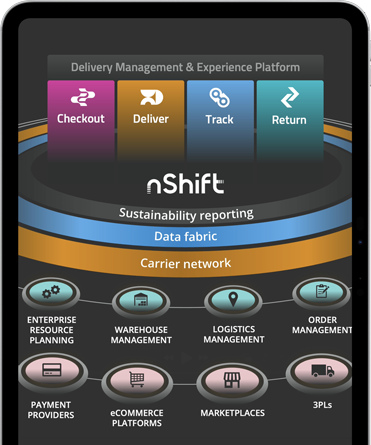
  • Modular, cloud-based delivery and experience management platform covering checkout, shipping, tracking, returns, TMS and analytics for retailers, 3PLs and logistics enterprises.
  • 1,000+ global carriers, 10,000+ carrier services, 450+ tech integrations, 70+ PUDO / OOH networks (~1.2M locations), plus shipment-level emissions reporting aligned with ISO 14083, EN 16258 and the GLEC Framework.  
  • Used by organizations that need end-to-end control across checkout, fulfillment, last mile and returns, not only post-purchase touchpoints, with flexibility to support complex, multi-region delivery setups.

AfterShip

  • All-in-one SaaS suite with a strong post-purchase focus: shipment tracking, branded notifications, returns, AI-powered EDD, warranty management, and multi-carrier shipping.
  • Vendor-stated 1,200+ global carriers as of late 2025 and a UPU Consultative Committee Bronze member.
  • Designed primarily for e-commerce brands and marketplaces seeking fast rollout and branded post-purchase experiences.  
logo-millesima-us-blanc

“A driving force for our growth”

Millesima used nShift to quickly connect to carriers across Europe, avoiding the time and cost of setting up each carrier individually — saving around €40,000 per carrier and accelerating its expansion into new markets. 

Product suite coverage
nShift vs. AfterShip

nShift

8 /month

AfterShip

16 /month

nShift

AfterShip

Product suite coverage

Multi-carrier integration
1,000+ carriers globally; 450+ tech integrations; 70+ PUDO; ~1.2M+ locations; strong coverage in Europe. [1].
1,200+ carriers globally as of 2025; count updated frequently[12].
Checkout optimization
Checkout widget/API with delivery options, ETA and 1.2M+ PUDO/OOH locations [3].
AI-powered EDD, address validation; delivery prediction [4].
Shipping management
Rule-based shipping logic; supports complex, multi-carrier workflows [1][10].
Automated shipping API; Automation rules [5][13].
Label printing
Bulk & complex order support [1].
Label generation; shipping API [7][8].
Tracking
Branded tracking; vendor-reported reduction in WISMO calls of up to 50% [11].
Proactive branded delivery updates [12][13].
Returns management
Vendor-reported conversion of up to 30% of returns into exchanges [14].
Branded self-service portal; rules, approval flows [16].
Sustainability & emissions
Shipment-level CO₂e reporting aligned with ISO 14083, EN 16258 and the GLEC Framework [17].
Carbon emissions reporting based on GHG Protocol methodology, SGS-certified [18].
ERP/WMS integration
ERP/WMS/TMS integrations with 450+ pre-built connectors [10].
70+ prebuilt integrations (e-com, marketing, some OMS/3PL) plus open APIs [20].
Enterprise readiness
Built for complex, multi-warehouse, multi-country operations, with ERP/WMS/TMS integrations and partner ecosystem focused on enterprise rollouts [19].
Targeted at mid-size and enterprise e-commerce brands, with native integrations to major e-commerce platforms and 3PL APIs [21].

Operational details

Time to first label
Sales-assisted onboarding; varies by integration [22].
Self-serve/API setup, first label potentially in minutes for standard setups [23][24].
Who configures rules
Admin or implementation partner [46].
Retailer admins; templates; sandbox [5].
Onboarding help
Project-based; solution architects/partners [47].
Free trial; dashboard guidance; help center [25][26].
Support channels
Support portal/email; phone for enterprise [27].
Online help/email/tickets; support team/dashboard [28].
Support hours
Standard help desk in business hours (local), with extended hours on Premium and 24x7 critical-incident coverage via Emergency Response Center on Enterprise SLA [29].
Standard support in business hours; Silver/Gold & Premium tiers offer faster SLAs and 24x7 coverage for critical issues [30].
SLA
Documented SLA with 99.9% uptime and tiered support (Essential–Enterprise), including 24x7 critical-incident cover at Enterprise level [31].
SLA guarantees 99.9% monthly uptime (per SLA); marketing claims 99.99%+ observed API uptime [32].
Sandbox / test
Built-in Checkout test & developer mode, plus Ship “Test Mode” and carrier-specific test flows for safe pre-production validation [33].
Developer sandbox, API docs/keys [34].
Docs & SDKs
Public REST API documentation, implementation guides, built-in Developer Tools, and webhook-style event exports (PortalData, Webshipper webhooks) [35].
REST APIs, webhooks, rate/address validation, docs [36].

Commercial & contracts

Pricing model
Custom enterprise (contact sales) [37].
Published plans; tiered subscription [38][39].
What's included
Core delivery management (Ship) with modular add-ons: Checkout, Track (branded tracking & notifications), Returns, and Emissions Tracker [48].
Core tracking; add-ons for Returns, Warranty, EDD [40].
Add-ons/modules
Optional modules for Checkout, Track (branded tracking & notifications), Returns and Emissions Tracker [49].
AI EDD, Returns, Warranty, Analytics [41].
Usage drivers
Annual shipment/label volume (tier), carriers in use, enabled modules, and support/SLA level [50].
Monthly shipment count, plan tier, add-ons, and support level [42].
Integration effort
Setup for rules, ERP/WMS/TMS; partners opt [10].
Self-serve via dashboard, custom API code [43].
Contract terms
Subscription-based; term set in the Subscription Agreement; SLAs defined in product-specific appendices [44].
Monthly/annual billing; free trial [25].
TCO lens
Scales with volume, modules, integration depth [31].
Cost scales with shipment volume and plan; minimal upfront setup cost [45].
1064-hunkemoller-white

“We’ve made returns part of a seamless omnichannel”

nShift helped Hunkemöller transform returns, offering more convenience, choice, and communication—driving loyalty while protecting revenue. The results?  +15% shift to in-store returns. 

Key differentiators
nShift vs. AfterShip

nShift

Built for complexity at scale

  • Physical delivery & PUDO footprint - Connects to 1,000+ carriers and 70+ PUDO/out-of-home networks, exposing ~1.2M pickup locations across EU/UK/Nordics and beyond. Strong fit for retailers needing dense locker, PUDO, and store-pickup coverage orchestrated in one place. [51] 
  • Deep backend integration - 450+ pre-built integrations into ERP, WMS, OMS, TMS, and e-commerce platforms enable end-to-end delivery orchestration, extending beyond post-purchase tracking. Well suited to complex, multi-warehouse, multi-country operations.
  • Standards-aligned emissions reporting - Shipment-level CO₂e aligned with ISO 14083, EN 16258 and GLEC, designed to support CSRD-grade reporting and audits. Strong choice for EU businesses with formal sustainability disclosure obligations. [52]

AfterShip

Predictive delivery information

  • AI-driven experience layer - AI Estimated Delivery Date (AI EDD), AI-powered product recommendations on tracking pages, and intelligent status normalization. Ideal for brands prioritizing predictive delivery information and revenue-generating post-purchase UX. [53]. 
  • Post-purchase experience suite - Branded tracking, notifications, returns, warranty workflows, and marketing-friendly components as a modular SaaS stack. While nShift also offers tracking and returns, AfterShip’s core positioning is CX and engagement. [53]
  • Fast, self-service deployment & transparent pricing - App-store style integrations, API keys, first-label-in-minutes setup, and public tiered pricing make it easy for e-commerce brands and mid-market players to start small and scale.
stenstroms-logo-400x200-white

“What makes nShift an ideal partner is that, as we grow, nShift will grow with us.”

By working with nShift, Stenströms has transformed the online shopping experience and increased revenue in major markets such as Germany, Canada and UK. Overall, Stenströms has increased international shipments by 153%.

Why brands choose nShift

28%

increase in order value

topformula-logo-200x400

1M

shipments per year
handled 95% faster

fbox-400x200

5M

shipments per year handled seamlessly
elgiganten-logo-400x200

1,000

hours per year saved with automation

stihl-400x200

40%

more efficient picking process

jysk-400x200

What it means

Stay through startup to enterprise with each. Both can support significant growth - nShift offers more headroom for complex needs, while AfterShip modular plans are scalable across global markets.
Checkout-badges-no-2
Checkout-badges-no-3
Checkout-badges-no-4
Checkout-badges-no-5

nShift side: "Robust planning and orchestration at scale."

Well-suited for enterprises and high-volume shippers that need rule-based checkout and shipping, multi-carrier and PUDO/OOH orchestration, ERP/WMS/TMS integrations, and standards-aligned emissions reporting. Established footprint and customer base in EU/UK/Nordics, with growing global carrier coverage.

AfterShip side: “Fast self-service rollout.” 

Well-suited for digital-first retailers and brands that prioritise fast self-service rollout, rich branded tracking and notifications, returns and warranty flows, and AI-enhanced post-purchase engagement, with modular plans that scale across global markets. 

iciw-logo-400x200-inverted

“A game-changer in terms of handling enquiries relating to orders”

Since adopting nShift Track, ICIW cut unbranded emails, reduced delivery queries by 50%, and now saves about €12,000 annually in customer service costs.


1,000+ carriers ready for you

ups-logo-400
gls-logo-400
DHL-logo-vector
postnord-logo-400
dpd-logo-400
movebbike-logo-400
db-schenker-logo-400
fedex-logo-400

Where each fits

 
icon-check-pink

Choose nShift

If you operate across multiple countries, need multi-carrier and PUDO options across regions, and require shipment-level emissions reporting aligned with ISO 14083 / EN 16258 / GLEC. nShift is also a good fit if you’re aiming for outcomes seen in customer examples, such as higher in-store returns or fewer “where is my order?” enquiries.

icon-check-black

Choose AfterShip

If you prioritize a self-serve start (free plan/trial), out-of-the-box integrations with major ecommerce platforms, and fast rollout of branded tracking, notifications, returns and warranty flows, with access to multiple carriers globally.

superdry-logo-400x200-inverted

“nShift is the right fit for our business”

nShift helps Superdry onboard carriers faster in new markets while providing stronger reporting capabilities.
FAQs

How many carriers do they cover?

nShift: 1,000+ globally (notably strong in EU/Nordics/UK);

AfterShip: 1,242 carriers (global network).

Which supports emissions/carbon reporting at checkout?

nShift: Shipment-level CO₂e aligned to ISO 14083, EN 16258, and GLEC. 

AfterShip: SGS-certified, GHG Protocol-based carbon reporting; no public claim of ISO 14083 / EN 16258 / GLEC alignment. 

Are both platforms SaaS and cloud-based?

Yes: Both are cloud-based SaaS platforms with APIs and enterprise security/compliance. 

nShift has particular depth in EU/UK/Nordics; AfterShip positions as globally oriented.

Who is the ideal user for each?

nShift: Complex, multi-location, high-volume retailers/3PLs;

AfterShip: E-commerce retailers, marketplaces, focused on post-purchase optimization. 

What is the integration effort?

nShift: Typically implemented via structured projects with deep ERP/WMS/TMS/API integration. 

AfterShip: Fast self-serve setup via native e-commerce integrations and APIs.
platform-tablet-cut

See nShift in action

platform-tablet-cut-7

Try our demo store

Customer stories

Understand how nShift helps businesses like yours

Don't just believe us, test nShift in a live demo

Get a personalized walkthrough—schedule your free demo at a time that fits your schedule.

Sources

We cite vendor primary pages and dated third‑party snapshots; “up to” figures are vendor‑reported. (Verified 07 Nov 2025)