
The ROI of delivery, part 2 of 3. A three-part series built on the report The ROI of nShift, a practical guide to delivery economics. You are reading part 2. See also part 1, the hidden cost of ecommerce delivery, and part 3, how to measure delivery ROI.

In this blog: why delivery management works on both sides of the P&L, how the four levers compound, and what it adds up to.
Yes, delivery management software pays for itself. It works on both sides of the P&L at once: the same platform lifts revenue at checkout while cutting cost in shipping, support, and returns. nShift models roughly EUR 2 million in conservative annual value for a midsize European retailer, and Harvey Nichols reported payback inside six months.
Most software affects one side of the business. Delivery management touches every order, and it moves both sides of the ledger at once, the revenue you bring in and the cost to fulfill. Delivery management software automates how orders get shipped, tracked, and returned across many carriers from one place, so small per-order gains add up across your whole volume.
“It pays for itself” is easy to say, so the rest of this shows the mechanism.
One order, run thousands of times a day
Think about a single order, end to end. It converts (or abandons) at checkout. It gets a carrier chosen and a label printed in the warehouse. It generates a tracking experience, or a support call. It may come back as a return, as a refund or an exchange. Every order runs that same loop, and a retailer runs the loop thousands of times a day.
The volume is what pays you back. Shave 90 seconds off carrier selection and it looks trivial on one order, until you multiply it by 150,000 shipments a year. Lift conversion by a single point and it looks modest on one session, until you apply it to 500,000 of them a month. The payback comes from improving the per-order economics of a transaction you already run at scale, then multiplying that by volume, which is why it arrives in quarters rather than years.
The four levers run on one platform
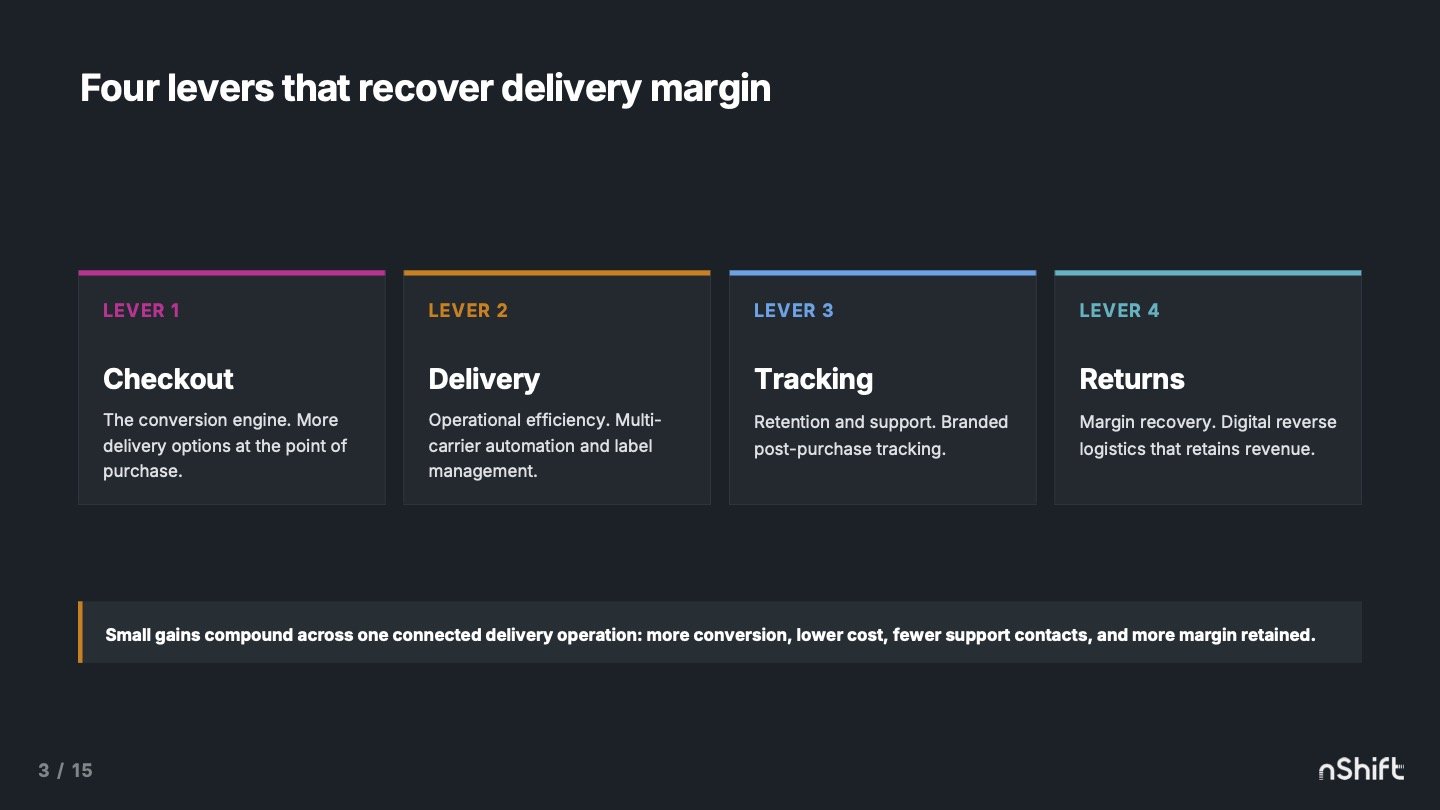
A delivery management platform gives you four levers on that order loop, and the point is that they run on the same infrastructure.
- Checkout puts the right delivery options in front of the shopper (home, pickup point, locker, time slot), which lifts conversion and basket size.
- Ship automates carrier selection, label printing, and booking across 1,000+ carriers, and rate-shops each parcel for the cheapest compliant option.
- Track gives a branded post-purchase experience that cuts WISMO calls and drives repeat purchases.
- Returns digitizes the return, steers refunds toward exchanges, and routes each parcel to the cheapest destination.
Run these as separate tools and you pay an integration tax at every handoff: a contract, a data model, and a set of carrier connections to maintain for each one. Run them as one platform and the handoffs disappear, which is where the compounding starts.
Why the gains compound instead of add
Separate point solutions give you separate returns that add up. One platform gives you returns that build on each other, and the reasons are concrete.
Shared carrier connectivity is where it starts. One carrier network and one integration serve checkout, shipping, tracking, and returns at the same time, so the connection you build for shipping labels also powers the delivery options at checkout and the status updates on the tracking page. You maintain it once.
Shared data comes next. The same shipment record that prints a label also feeds the ETA shown at checkout, the proactive notification that prevents a WISMO call, and the return routed back to stock. The data does not get re-keyed or reconciled across systems, so each lever makes the next one smarter.
And the marginal cost of the next move keeps falling. Once the platform is in place, switching on the next product or the next market is a configuration change rather than a fresh integration project. With the carrier network already connected, Somfy brought on a new carrier with almost no effort. Each new lever lands on infrastructure that already exists, so it costs less and ships faster than the one before.
“As easy as flicking a light switch.”
Somfy, on adding a new carrier through the nShift network
It holds at volume
Per-order math only pays out if the platform stays fast and stable as volume climbs. The proof is in the operators running it hard. Swedish fulfillment specialist F-Box handles a million shipments a year and processes them 95% faster after automating with nShift. Nordic electronics retailer Elgiganten moves 5 million parcels a year through the platform. Lighting manufacturer Glamox estimates a 15 to 30% gain in warehouse efficiency, and notes the same data gives it a better foundation for negotiating with carriers. These are steady-state numbers, what the everyday economics look like once a transaction runs at scale.
615%
more orders shipped
Hairlust, while expanding into 10 new markets
1M / 95%
shipments a year, processed 95% faster
F-Box, after automating shipping
5M
parcels a year through one platform
Elgiganten
The same stability earns the most when demand spikes. A platform that absorbs a peak-season surge without adding staff carries the per-order savings straight through peak, when volume multiplies them and the busiest weeks of the year do the most for margin.
The return keeps arriving after go-live
The ROI keeps growing after the first deployment. The larger value often arrives six months on, when a new market, another carrier, or an extra product becomes a weekend configuration change instead of an integration project with its own timeline and budget.
Danish haircare brand Hairlust shows the shape of it: a 615% increase in orders shipped and 642% revenue growth while expanding into 10 new markets, with the platform absorbing each new market rather than requiring a rebuild for it. Every market, carrier, and product you might switch on later is cheaper and faster because the infrastructure is already there, and none of it requires pulling developers off revenue work to keep carrier integrations alive. For a transformation lead trying to scale without expanding the IT backlog, that option value is the part of the return that keeps paying.
You can see that play out in 2026 alone: nShift shipped an official Checkout app for Shopify and AI-powered delivery estimates, and its checkout work won Checkout Automation Innovation of the Year at the RetailTech Breakthrough Awards. Each one runs on the same platform, so existing customers switch it on without a rebuild.
What it adds up to
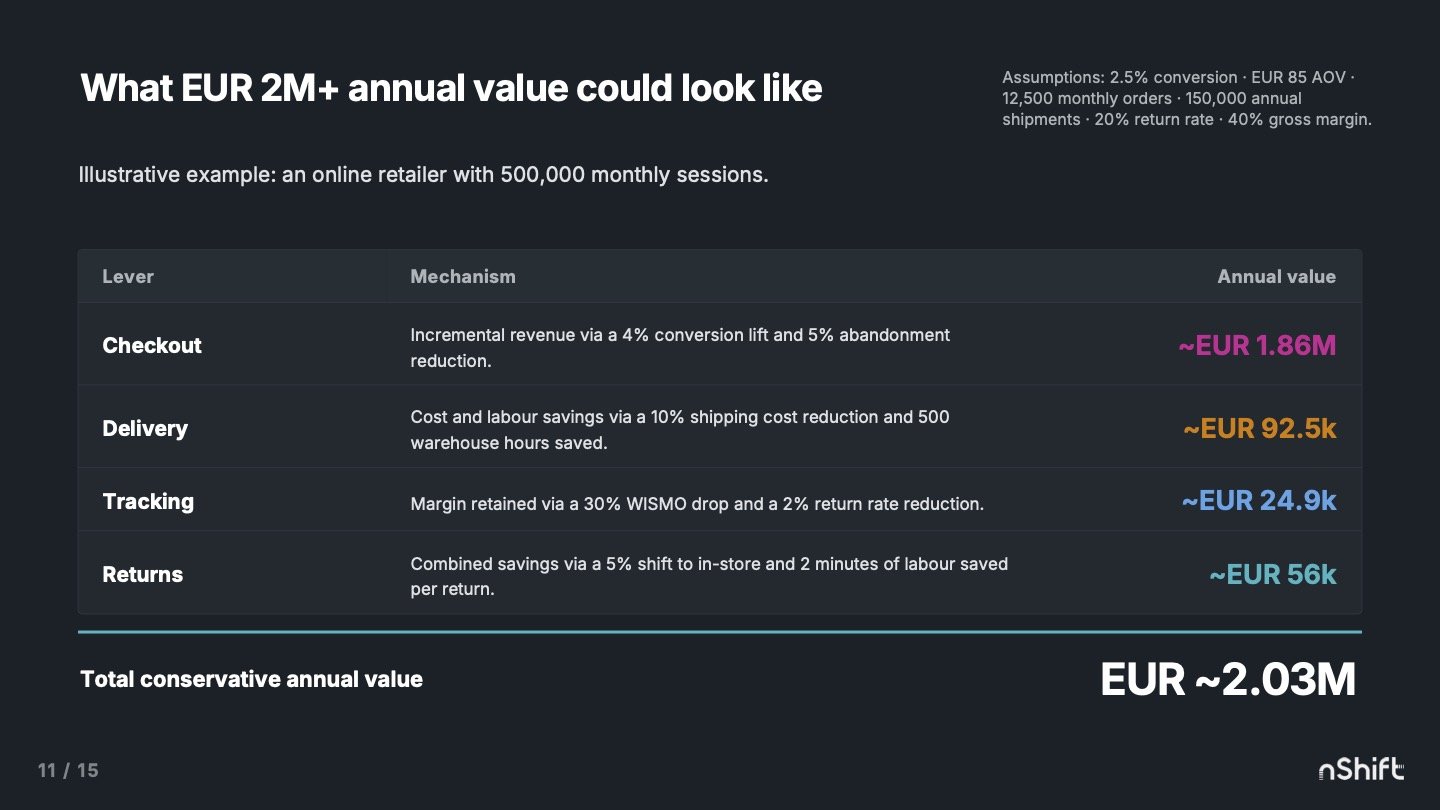
Put the four levers together for a midsize European retailer (500,000 monthly sessions, EUR 85 average order value, 150,000 annual shipments, 20% return rate) and the conservative model lands around EUR 2 million a year: roughly EUR 1.86 million from the conversion lever and EUR 173,000 from operational savings across shipping, tracking, and returns. The moderate scenario runs several times higher as the levers compound. The full model, with every assumption shown, is laid out in The ROI of nShift, which backs it with verified results from 38 named European retailers and third-party benchmarks from Baymard, NRF, Eurostat, Capgemini, and PwC.
So, yes, it pays for itself, for one underlying reason: it improves the economics of an order you already run at scale, on both sides of the P&L, on infrastructure you maintain once. Stitch the same capability together from separate tools and integration overhead, fragmented data, and maintenance eat into the return. Run it as one platform and the gains compound instead of leaking at the handoffs.
If you have not yet found the cost this recovers, Part 1 shows where it hides. When you are ready to put a defensible number on it for your own business, Part 3 gives you the baseline-first method.
Read the full model: The ROI of nShift · Book a demo