
The ROI of delivery, part 3 of 3. A three-part series built on the report The ROI of nShift, a practical guide to delivery economics. You are reading part 3. Start with part 1, the hidden cost of ecommerce delivery, and part 2, does delivery management pay for itself.

In this blog: how to baseline four numbers, build a defensible business case, and track delivery ROI from week one.
To measure delivery ROI, baseline four numbers before you buy: checkout abandonment, minutes per shipment, WISMO call volume, and return rate. Convert each to euros using your average order value and loaded labor rate, apply conservative improvement benchmarks, then track the same metrics from week one of go-live. The business case is then built from your own data rather than a vendor’s promise.
You do not need the platform to start measuring its return. Almost every input to a delivery ROI case is a number you can capture from systems you already run: your WISMO call volume, your minutes per shipment, your return rate, your checkout abandonment. Baseline those four today, apply conservative improvement benchmarks, and the business case writes itself from your data rather than a vendor’s promise. The platform then proves or beats the model after go-live.
Sequence it that way for a reason: most delivery investments disappoint because nobody captured the starting point before go-live, so the savings happen but never get measured.
Most ROI “failures” are measurement failures
When a delivery project gets graded as underwhelming, look first for a missing baseline. The savings were usually real; what is missing is the before-number to measure them against, because no one recorded the WISMO volume or the per-shipment time ahead of go-live. The win was real, but with nothing to compare against, it never made it into a report.
The fix is to make measurement the first task. Capture the baseline while you are still building the case, use the same metrics to model the return, and keep tracking them from week one of go-live. Do that and the ROI is documented as it arrives, instead of reconstructed from memory a year later when someone asks whether the investment paid off.
Build the baseline before you buy
Four numbers carry most of the case. You can pull all of them from existing tools this week.
| Baseline metric | Where to find it | What it feeds |
| Checkout abandonment and conversion rate | Analytics or shop platform | Revenue upside from better delivery choice |
| Minutes per shipment, label to dispatch | Warehouse management system | Labor saved through shipping automation |
| WISMO call or ticket volume | CRM or ticketing system | Support cost removed by branded tracking |
| Return rate and refund-to-exchange split | Returns platform or OMS | Margin recovered through better returns |
Add two reference figures from your own finance data: your average order value and your loaded warehouse hourly rate. With those, each baseline becomes a euro figure. WISMO volume times GBP 5.58 per call gives the support cost in play. Return rate times 21% of average order value gives the processing cost on the table (NRF and Happy Returns, 2024). Manual minutes per shipment times your hourly rate, across annual volume, gives the labor cost. You can do all of this before you have signed anything.
From baseline to business case
Now apply improvement benchmarks, and keep them conservative so the case survives scrutiny. The point of a defensible model is that the real result clears it, not that the headline number is large.
You can pull a worked version from The ROI of nShift, which compiles verified results from 38 named European retailers and third-party benchmarks (Baymard, NRF, Eurostat, Capgemini, PwC) into one ROI model you can adapt. For a midsize European retailer with 500,000 monthly sessions, EUR 85 average order value, 150,000 annual shipments, and a 20% return rate, the conservative model lands near EUR 2 million a year: a 4% conversion lift plus a 5% abandonment reduction worth roughly EUR 1.86 million, and operational savings across shipping, tracking, and returns worth around EUR 173,000. Swap in your own four baselines and the model rescales to your business. The delay has a price too: in that scenario the conversion lever alone is worth about EUR 155,000 for every month you wait, revenue that cannot be recovered after the fact.
Keep the model honest. No business deploys all four levers on day one, and results vary by starting maturity, so present the conservative figure as the floor and note the moderate case as upside. A finance reviewer trusts a model that states its assumptions more than one that promises a single big number.
What payback looks like
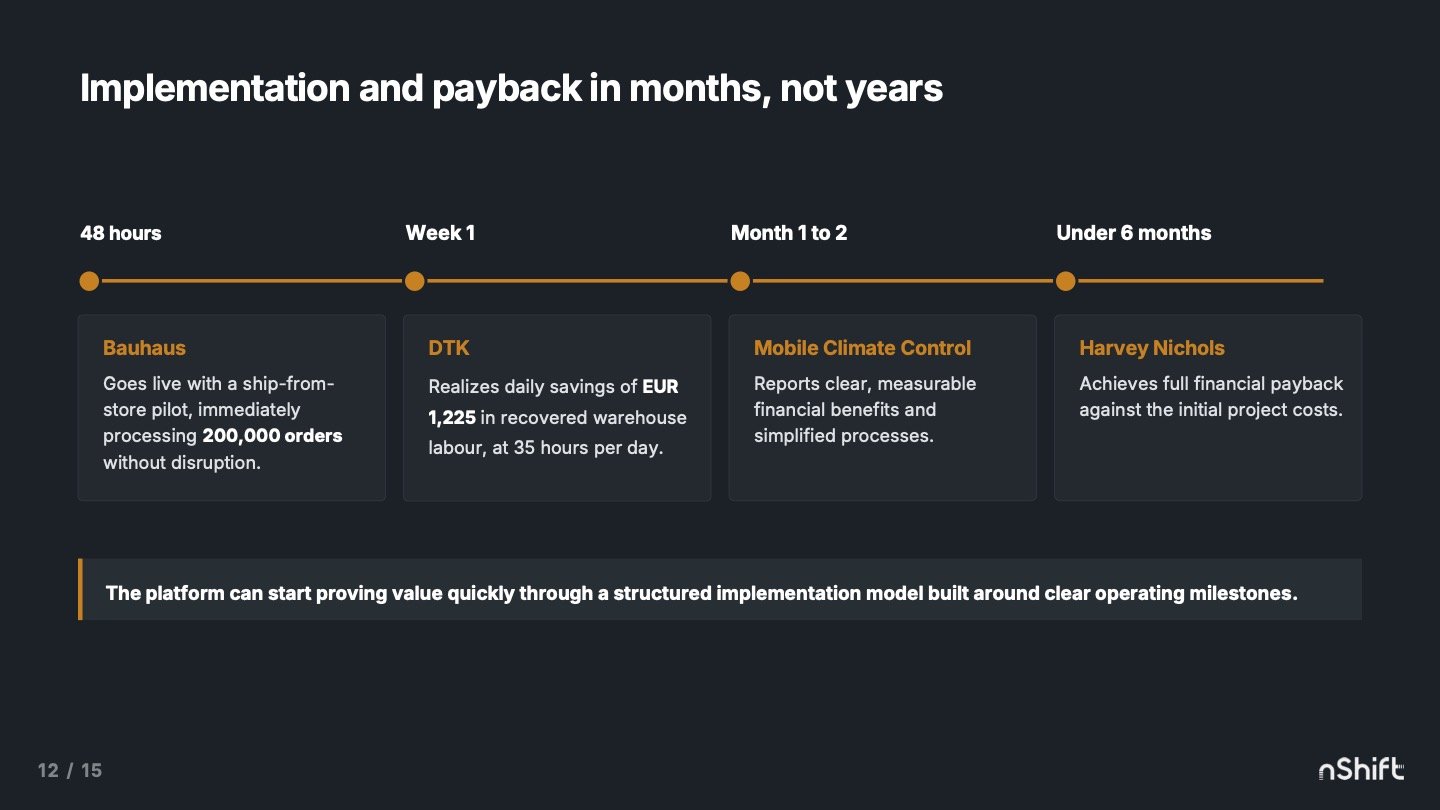
UK luxury department store Harvey Nichols reported payback from its initial project costs in under six months, going live in roughly a third of the timeline it was first quoted and with a wider set of carrier integrations than expected. RevolutionRace made fast go-live the priority and got it, expanding with flexible delivery choices instead of waiting on a long build. Both reached value in a matter of weeks.
Speed is itself part of the return. The sooner the first carrier is live, the sooner the conversion, labor, and support savings start accruing against the baseline you captured, which is why time to value belongs in the business case alongside the annual figure.
Setup is getting quicker, too: in 2026 nShift added Companion, an in-app AI assistant now in Track, that walks teams through configuration without waiting on support and shortens the path to the first measurable result.
<6 months
payback on initial project costs
Harvey Nichols
~EUR 2M
modeled conservative annual value
Midsize European retailer, all four levers
EUR 155k
lost per month of delay (Checkout alone)
From the conservative model
Measure it the same way after go-live
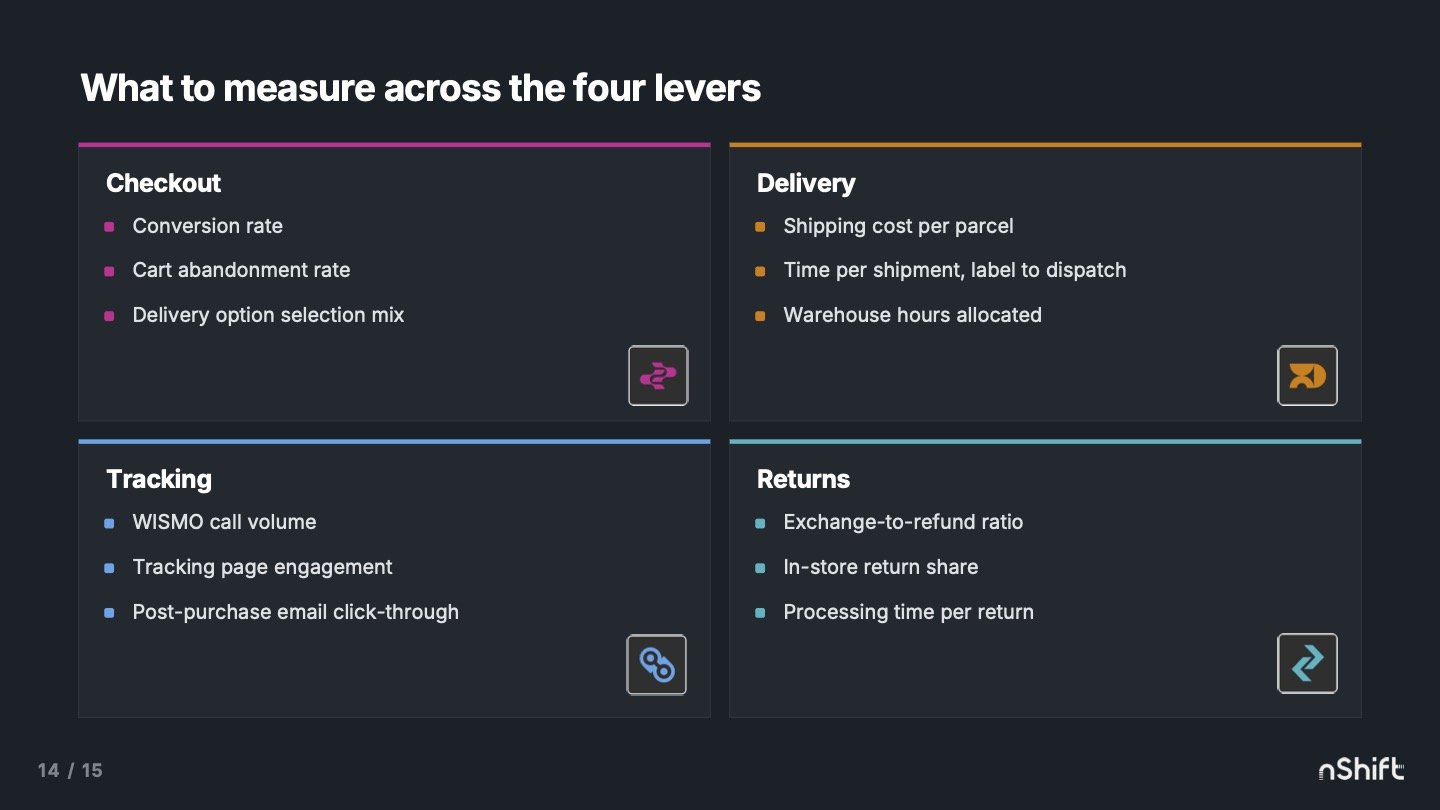
Once live, track the same metrics on a regular cadence so the return stays documented. A compact framework by product area keeps it simple.
- Checkout: conversion rate, abandonment rate, average order value, delivery-option mix. Weekly to monthly.
- Ship: shipping cost per parcel, time per shipment, rate-shopping savings, warehouse hours on shipping. Monthly to quarterly.
- Track: WISMO volume, tracking-page engagement, post-purchase email click-through, delivery NPS or CSAT. Monthly to quarterly.
- Returns: return rate, exchange-to-refund ratio, in-store return share, processing time per return. Monthly to quarterly.
Assign each metric an owner and a baseline source before go-live, and the after-state is captured automatically as it improves. It also keeps the business case alive past year one: the same dashboard that proves the first year’s return shows where the next lever or the next market is worth switching on.
The build-versus-buy line in the case
One comparison belongs in any honest model: the cost of doing it yourself. Building carrier integrations in-house means owning every carrier API change, every new-market connection, and every label-format update, with developers maintaining plumbing instead of shipping revenue features. Finnish fishing retailer Happy Angler reached that verdict after weighing nShift against a custom build of its own. Swedish fashion brand Gina Tricot frames the upside as headroom, with “no limit to how much we can grow and the changes we can make ourselves without the support of expensive and time-consuming development.” Put the internal-build cost in the comparison and the platform case usually strengthens, because the build option keeps charging maintenance for years.
“Much more cost-effective than if we had created our own custom solution.”
Happy Angler, on choosing nShift over an in-house build
Weigh resilience in the same breath. nShift’s 2026 guide on single-carrier risk shows how leaning on one carrier exposes a retailer to disruption, lost conversions, and capacity limits that a multi-carrier platform absorbs.
That is the full method: baseline four numbers from systems you already run, model the return with conservative benchmarks, and track the same metrics from week one so the result is documented as it lands. nShift runs all four levers (checkout, shipping, tracking, and returns) on one platform across 1,000+ carriers, so the same dashboard proves the return and shows where to expand next. The platform’s job is to beat the model. Your job, before you sign anything, is to make the model defensible.
Start with the cost this recovers in Part 1, see why the levers compound in Part 2, then bring the numbers here.
Read the full model: The ROI of nShift · Book a demo