Black Friday & Peak Season 2026

Protect the margin on your peak-season orders

Black Friday generates more than twice the shipments of a regular Friday on the nShift platform. Let's help you keep more of what those extra orders earn.

Use nShift data and retailer examples to understand where peak season pressure spikes, what customers need and which costs to keep under control.

nShift platform data

Black Friday more than doubled Friday shipment volume in 2025

Black Friday 2025

2x

More than twice the shipments of an ordinary Friday in early November, two years running.

Around Black Friday

Black Week weekend

4x

an ordinary Saturday, and 2.8x an ordinary Sunday. On that Saturday alone, shipments reached 90.8% of an ordinary Tuesday.

Where the extra shipments went

60%

of the shipments above an average early-November week went out before or after Black Week. The busiest day was Cyber Monday, with 8% more shipments than Black Friday.

Every day, late October to Christmas

  • Shipments, 2025
  • 2024 (outline)
  • Average early-November day

Hover or use the arrow keys to read any day. Switch year to compare.

2025: shipments each week compared with an average early-November week, and each week’s share of all shipments above it
WeekMultiple of the average weekShare of shipments above the average week
Week of 27 October 20250.93x
Week of 3 November 20250.96x
Week of 10 November 20251.04x
Week of 17 November 20251.25x14%
Week of 24 November 20251.74x40%
Week of 1 December 20251.47x25%
Week of 8 December 20251.26x14%
Week of 15 December 20251.13x7%
Week of 22 December 20250.47x
2024: shipments each week compared with an average early-November week, and each week’s share of all shipments above it
WeekMultiple of the average weekShare of shipments above the average week
Week of 28 October 20240.94x
Week of 4 November 20240.97x
Week of 11 November 20241.03x
Week of 18 November 20241.22x13%
Week of 25 November 20241.72x41%
Week of 2 December 20241.44x25%
Week of 9 December 20241.28x16%
Week of 16 December 20241.09x5%
Week of 23 December 20240.48x

Source: nShift platform data, outbound shipments across the whole platform, late October to the end of December, 2024 and 2025.

The Black Friday sale is only the start

Checkout resilience, carrier capacity, returns and freight invoices all affect the margin those orders leave behind.

IMRG Research

Is your returns policy costing you Black Friday sales?

85.6% of UK shoppers say the returns policy matters when deciding whether to buy online. IMRG and nShift asked 1,000 UK consumers how return charges, exchanges and policy choices affect where they shop.

Cover of The Ecommerce Returns Opportunity report by IMRG and nShift

Get the report:

  • How returns policies and charges affect where people shop
  • Why fit drives returns, and how many shoppers would take an exchange instead of a refund
  • Five takeaways from IMRG and five practical tips from nShift

Demand & capacity

Before the sale: get ready for spikes

Plan for the peaks you actually have

Black Friday data can give you a benchmark, but your busiest days depend on your own campaign calendar, market mix, lanes and carrier capacity.

Turn your forecast into carrier capacity

Plan dispatch dates and lanes from your campaign forecast. Confirm the number of parcels each carrier has agreed to collect each day, and arrange an alternative for your busiest lanes before the campaign starts.

Test your carrier resilience Measure carrier performance →

Plan each market separately

The same peak does not hit every market the same way.

Across seven nShift sending markets, Black Week 2025 shipment uplift ranged from 44% above an average week for Finland to 112% for the UK. 
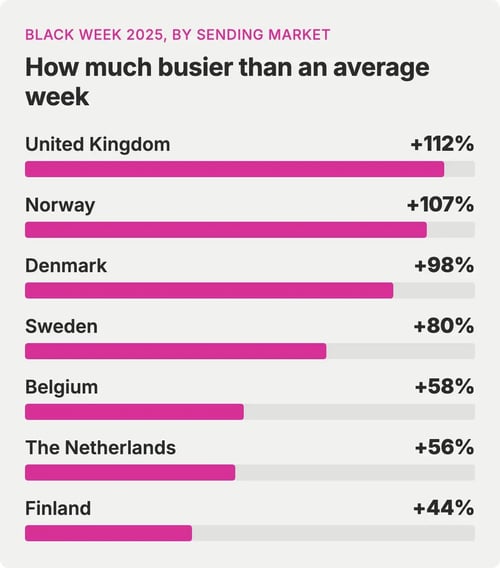
Bar chart: Black Week 2025 shipments compared with an average 2025 week, by sending market. United Kingdom +112%, Norway +107%, Denmark +98%, Sweden +80%, Belgium +58%, the Netherlands +56%, Finland +44%.
Source: nShift platform data, outbound shipments by country of sending. Black Week was 24 to 30 November 2025.

Build the forecast market by market rather than applying one regional multiplier.

Read the Nordic 2025 analysis →

Your own campaigns create your peaks

A promotion you control can concentrate demand into minutes rather than days.

Forecast from your own campaigns first. Use Black Friday data to pressure-test the plan.

Customer story: Stockmann

On Crazy Days, morning orders can jump to around 30 times a normal day

When Stockmann's Crazy Days campaign opens, wishlists turn into orders within minutes. With nShift Checkout, Stockmann keeps checkout fast and stable through the surge.

2,000+
checkout API calls per minute
~30 sec
to update delivery methods
“If the checkout cannot handle this load, the success of the entire campaign is at risk.” Jari Reinikainen, Logistics Director, Stockmann
Read the Stockmann story

Delivery options at Checkout

Keep checkout flexible when demand changes

nShift Checkout lets teams control delivery options, carrier choice and rules at checkout without rebuilding the experience for every campaign. Delivery estimates and available services can reflect what the operation can support as demand changes.

nShift Checkout: load-tested at 1,200 requests per second.
nShift Checkout: 1,000+ carriers worldwide and 1.2M+ pickup and drop-off (PUDO) points.
nShift Checkout: AI-powered delivery estimates.
nShift Checkout: award-winning checkout automation. Parcel and Postal Technology International Awards 2025 winner, E-commerce Fulfilment Technology of the Year.
nShift Checkout: rules you control without code.

Delivery promise

From checkout to doorstep: keep your word

Make commitments you can keep

Customers need delivery choices they understand, an estimate the operation can support and clear updates if the plan changes. Peak pressure makes all three harder.

How strong is your delivery promise?


75% of retailers say delivery shapes conversion, loyalty, and brand. This health check shows whether your delivery promise fuels growth or puts revenue at risk.

  • Answer 10 quick questions (about 2 minutes, no signup)

  • Get your score and persona (Anchor, Dynamo, or Superstar)

  • See where to act (recommendations for peak readiness and daily performance)

Start the assessment

Keep the promise credible after checkout

Across 115,000+ Nordic delivery ratings from December 2025, most ratings were positive, but the average score slipped as the month went on. Negative comments clustered around delays, missing notifications and pickup points customers had not expected.

Show a delivery estimate the available data can support and the full delivery cost at checkout. If that promise changes, tell the customer before they have to ask.

Read what 115,000 delivery ratings show →

Answer “where is my order?” before it is asked

Next to precise delivery dates at checkout, proactive updates in flight reduce the questions customer service would otherwise handle.

Poor tracking updates lead to uncertainty and a flood of WISMO calls. They eat time, erode loyalty, and cost an average of €12 each, while also failing to reengage your customers.

What happens when tracking goes quiet →

Customer story: VITA

VITA built its delivery promise on what its carriers can support

VITA, one of Norway's largest beauty retailers, connected checkout, warehouse and carriers in one flow. Delivery managers can check that each promise is met and change carrier options when performance or customer needs change.

30 min
click-and-collect from VITA stores
Next day
delivery to large parts of Norway
“With nShift, we’re able to deliver on our promise every single day.” Kristian Sonnenberg, Chief of Digitalization & Technology, VITA
Read the VITA story

Keep more carrier options open

nShift connects to more than 1,000 carriers across 190 countries, including 70+ pickup and drop-off networks with more than 1.2 million locations.

That gives delivery teams more options when capacity, performance or customer needs change.

Returns

After delivery: keep the sale

A return can still end in revenue.

Decide the returns policy before the promotion starts

Returns happen after delivery. The policy affects the sale before checkout.

Set the return window, any charges and exchange options before the campaign goes live, and make them easy to find before the customer buys.

If you charge for returns, choose the rule deliberately


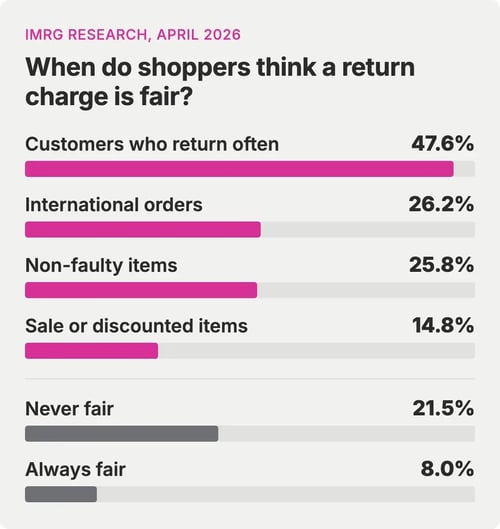
UK shoppers do not reject return charges in every circumstance.

Bar chart: situations where UK shoppers think a return charge is fair. Customers who return often 47.6%, international orders 26.2%, non-faulty items 25.8%, sale or discounted items 14.8%. 21.5% said it is never fair and 8.0% said it is always fair.
Source: IMRG for nShift, The Ecommerce Returns Opportunity, survey of 1,000 UK consumers, April 2026.

Use the policy to reflect the order, campaign or customer situation rather than assuming one rule fits every return.

Learn about Returns rules

Make exchange easy when it solves the problem

Fit was the return reason UK shoppers cited most. 66.1% said they would likely take an easy exchange instead of a refund if one were offered.

When a different size solves the problem, make that option easy to choose.

Want the full shopper research? 

Get the IMRG report

Customer story: Hunkemöller

More Hunkemöller shoppers now return in store

Hunkemöller replaced printed return labels with a digital returns journey across six European markets. A return in store gives staff the chance to help the customer and sell again, and warehouse teams see expected return volumes days in advance.

15%
more in-store returns
Days ahead
warehouse view of expected return volumes
“What was a historical pain point for the company and our customers has been changed into something that adds real value.” Robin Visser, Omni Channel Business Development Manager, Hunkemöller
Read the Hunkemöller story

IMRG for nShift, 2026

What do shoppers expect when they send something back?

Top return reason

57.6%

of UK shoppers say an item not fitting is one of their most common reasons for sending it back.

Around the return

A denied return

30.1%

would stop shopping with a retailer that denied their return or refund. Only 9.6% would accept the decision.

Time to start a return

47.4%

expect it to take one to three minutes, through a returns form or online portal. 9.7% expect it to be almost instant.

How important is a retailer’s returns policy to you when deciding whether to make an online purchase?

One answer per shopper.

    Step 1, Before they buy: How important is a retailer’s returns policy to you when deciding whether to make an online purchase?
    Very important45.6%
    Quite important40.0%
    Neutral9.8%
    Not very important3.8%
    Not important at all0.8%
    Step 2, Why it comes back: Thinking of the times when you returned items you bought online, what has been the most common reason/s?
    Item doesn’t fit57.6%
    Poor quality50.8%
    Item arrived damaged45.9%
    Item doesn’t match description/images37.6%
    Changed my mind11.9%
    Ordered multiple options intentionally10.1%
    I never return items I purchase online7.3%
    Other0.9%
    Step 3, Starting the return: How long do you expect it to take to initiate a return (e.g. completing a returns form or online portal)?
    Less than 1 minute, it should be almost instant9.7%
    1–3 minutes, quick and simple47.4%
    3–5 minutes, acceptable if straightforward30.1%
    5–10 minutes, fine if detailed8.4%
    More than 10 minutes, I expect a thorough process4.4%
    Step 4, Exchange or refund: If a retailer offered you an easy exchange option at the point of return, how likely would you be to exchange an item rather than request a refund?
    Very likely20.9%
    Likely45.2%
    Neither likely or unlikely26.5%
    Unlikely5.5%
    Very unlikely1.9%
    Step 5, If you say no: If your return or refund is denied, what would you expect to happen next?
    A clear explanation of the decision61.0%
    The ability to take it up with customer service51.3%
    A quick alternative solution (e.g. credit or exchange)46.0%
    I would stop shopping with that retailer30.1%
    I would accept the decision9.6%
    I am unsure2.9%
    Other0.3%

    Source: IMRG for nShift, The Ecommerce Returns Opportunity, 2026. Survey of 1,000 UK consumers aged 18+, completed April 2026.

    One platform across the delivery journey

    nShift connects checkout, shipping, tracking, returns and freight invoice audit across one multi-carrier platform, so teams can manage the delivery journey from the promise made before purchase to the costs that appear afterwards.

    Learn more →

    Delivery & Experience Management PlatformnShift platform: products, AI and data layers, carrier network and connected systems.3PL/4PLCXECOMMERCEERPLOGISTICSMARKETPLACESOMSPAYMENTSWMS3PL/4PLCXECOMMERCEERPLOGISTICSMARKETPLACESOMSPAYMENTSWMSCarrier networkDelivery & Experience Management Platform Checkout Deliver Track Return AuditData fabricAgentic AIDelivery & Experience Management PlatformCheckoutDeliverTrackReturnAudit3PL/4PLCXECOMMERCEERPLOGISTICSMARKETPLACESOMSPAYMENTSWMSAgentic AIData fabricCarrier network3PL/4PLCXECOMMERCEERPLOGISTICSMARKETPLACESOMSPAYMENTSWMS

    Peak costs

    Weeks later: count the real cost

    The final bill lands long after the sales report.

    Check what the peak actually cost

    Sales and shipment volumes are visible quickly. Some delivery costs are not.

    Returns, support work and carrier charges can continue after the campaign, so the final cost of an order may only become clear later.

    Where the cost appears

    Margin on a Black Friday order

    1. Order dayThe discount reduces revenue.
    2. DispatchPicking, packing and shipping.
    3. In transitDelivery changes and customer questions.
    4. Return windowReturns, refunds and exchanges.
    5. Carrier invoiceThe final freight charges become visible.
    Illustrative sequence. Timing varies by business, carrier and return policy.

    A discount reduces the revenue from an order. Delivery, support and return costs still need to be covered, while some carrier charges may not be visible until the invoice arrives.

    Check carrier invoices against what actually shipped

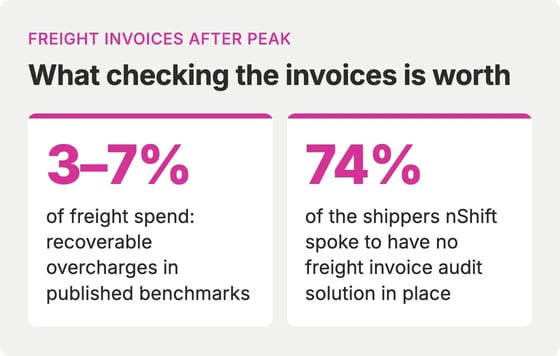
    Match invoice lines to the shipment and the contracted rate, so incorrect prices, unexpected surcharges and other discrepancies can be investigated with evidence.

    Two figures. 3 to 7% of freight spend: recoverable overcharges in published freight audit benchmarks. 74% of the shippers nShift spoke to have no freight invoice audit solution in place.

    Use our freight invoice audit guide to review a sample of your own invoices and see where errors can hide.

    Get the freight invoice guide

    Shipping stock to stores and warehouses for peak

    Stores, warehouses and business customers need their stock before shoppers need their parcels. For B2B shippers, the peak puts pressure on delivery slots and pallet space, and brings disputes over what arrived.

    How to stay ahead
    Keep a shipment record for each B2B delivery, so a dispute can be settled from it.

    Read the B2B shipping guide →

    Carrier invoice audit software

    More shipments, more freight overcharges to recover

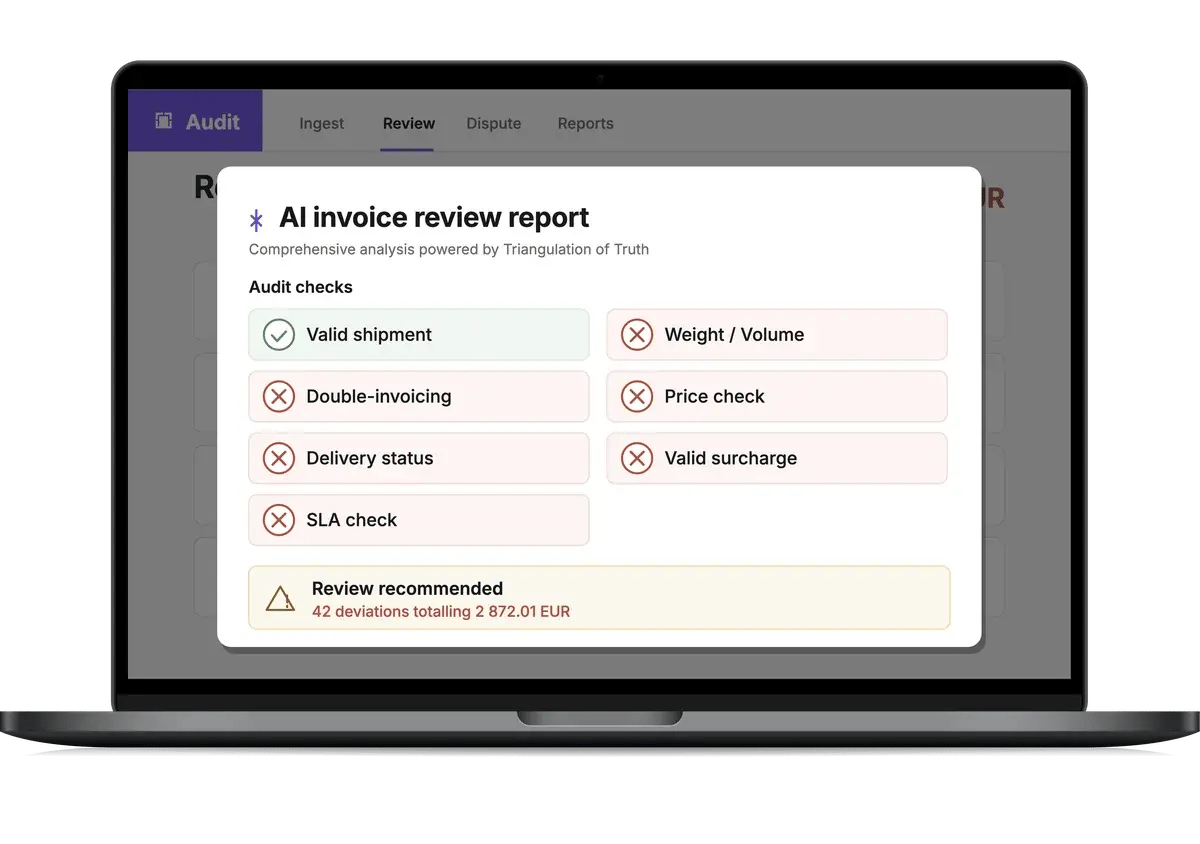
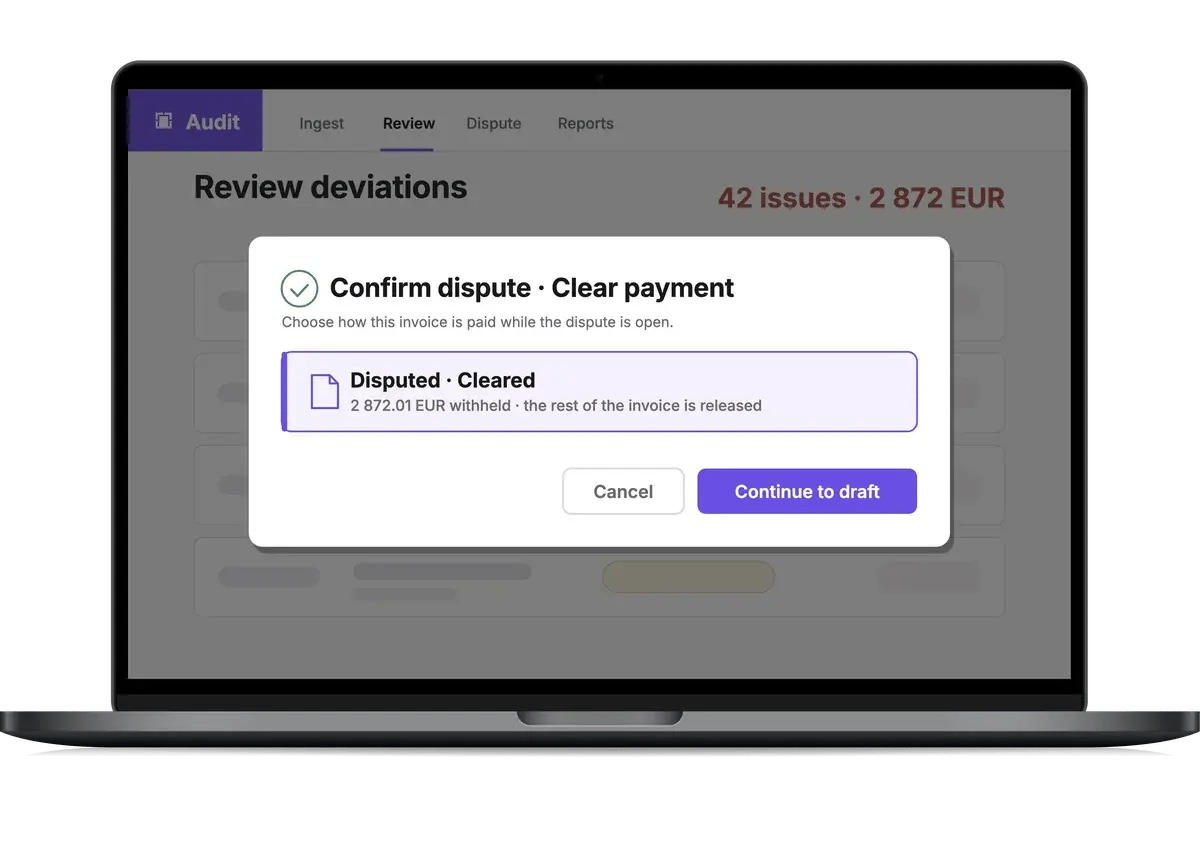
    nShift Audit reads carrier invoices in the format they arrive and checks each line against shipment data and contracted rates. It flags discrepancies, keeps the supporting evidence with each issue, and gives teams one place to review, raise and track disputes.

    nShift Audit screen: AI invoice review report with seven audit checks (valid shipment, weight and volume, double invoicing, price, delivery status, valid surcharge and SLA). Example result: review recommended, 42 deviations totalling 2,872.01 EUR.
    nShift Audit screen: confirm a dispute and clear payment. Example: 2,872.01 EUR withheld while the rest of the invoice is released.
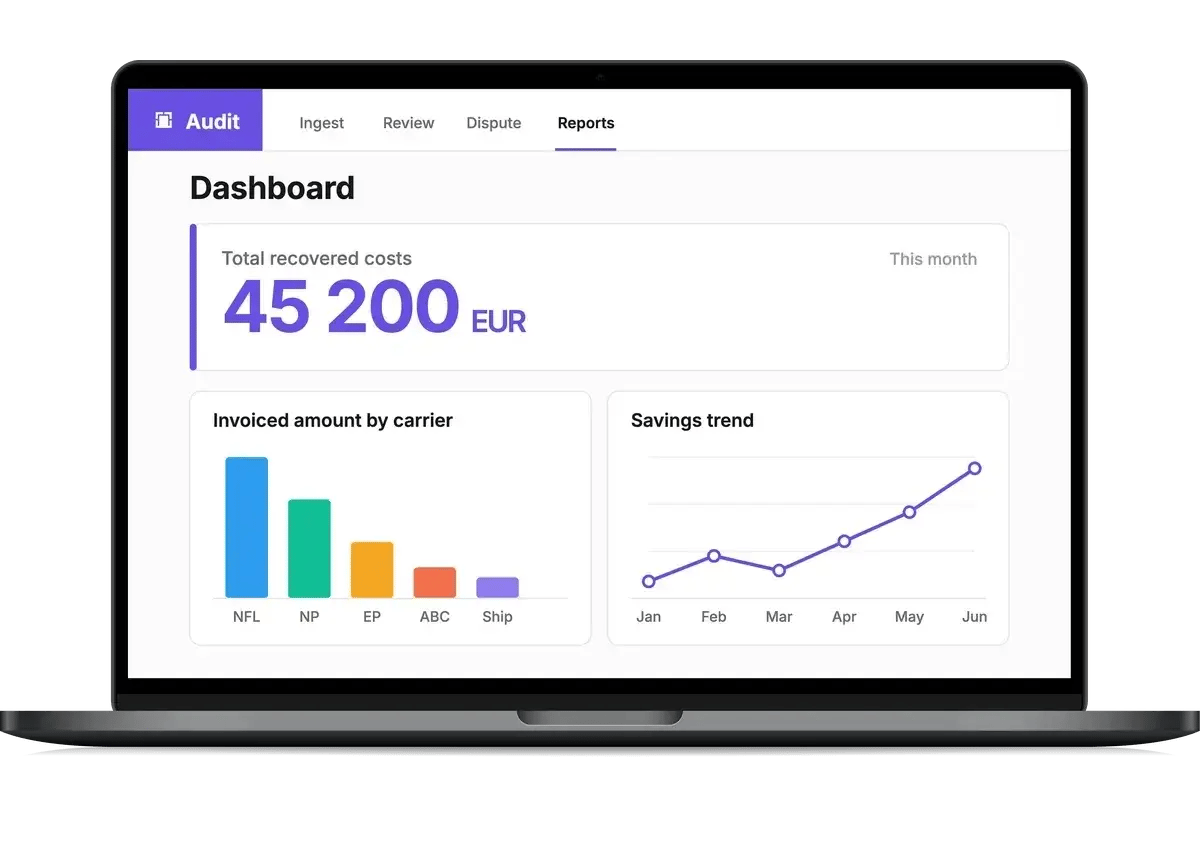
    nShift Audit dashboard: total recovered costs this month (example: 45,200 EUR), invoiced amounts and a savings trend from January to June.
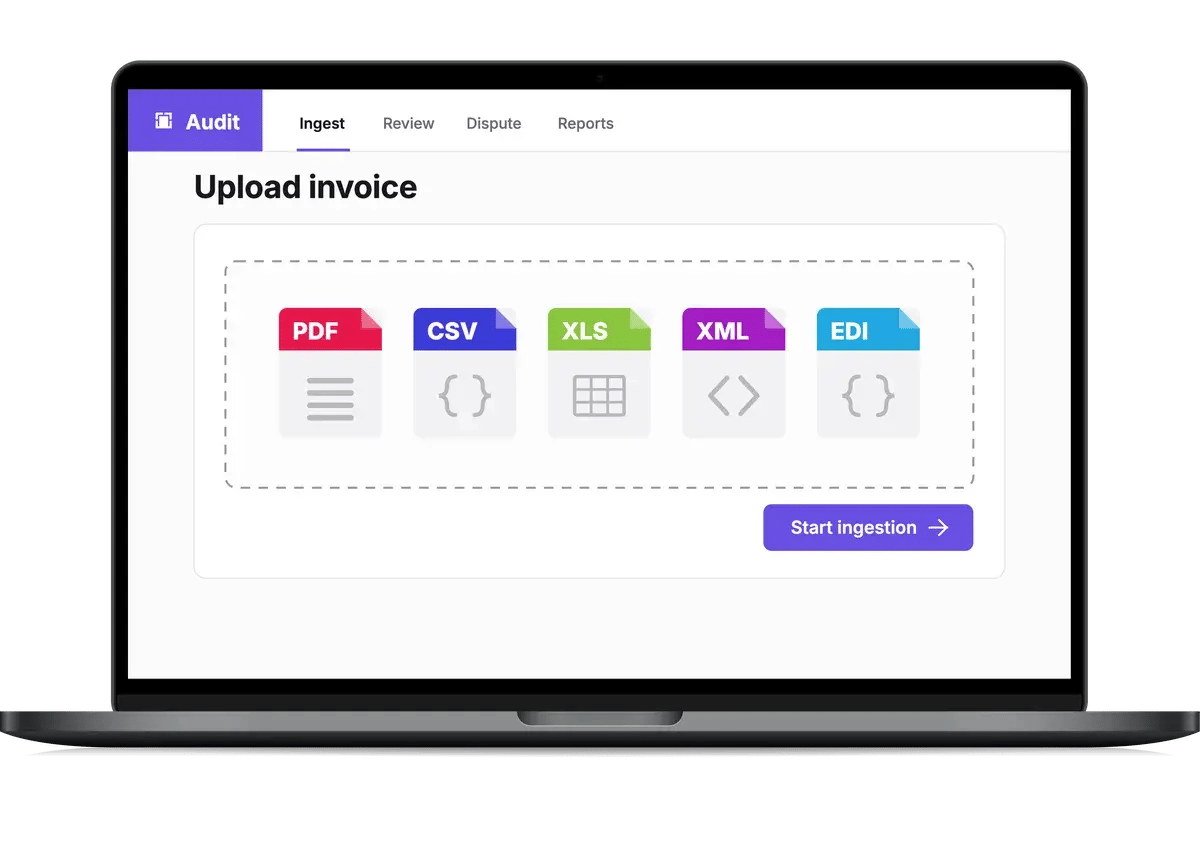
    nShift Audit screen: upload invoices in PDF, CSV, XLS, XML or EDI format.
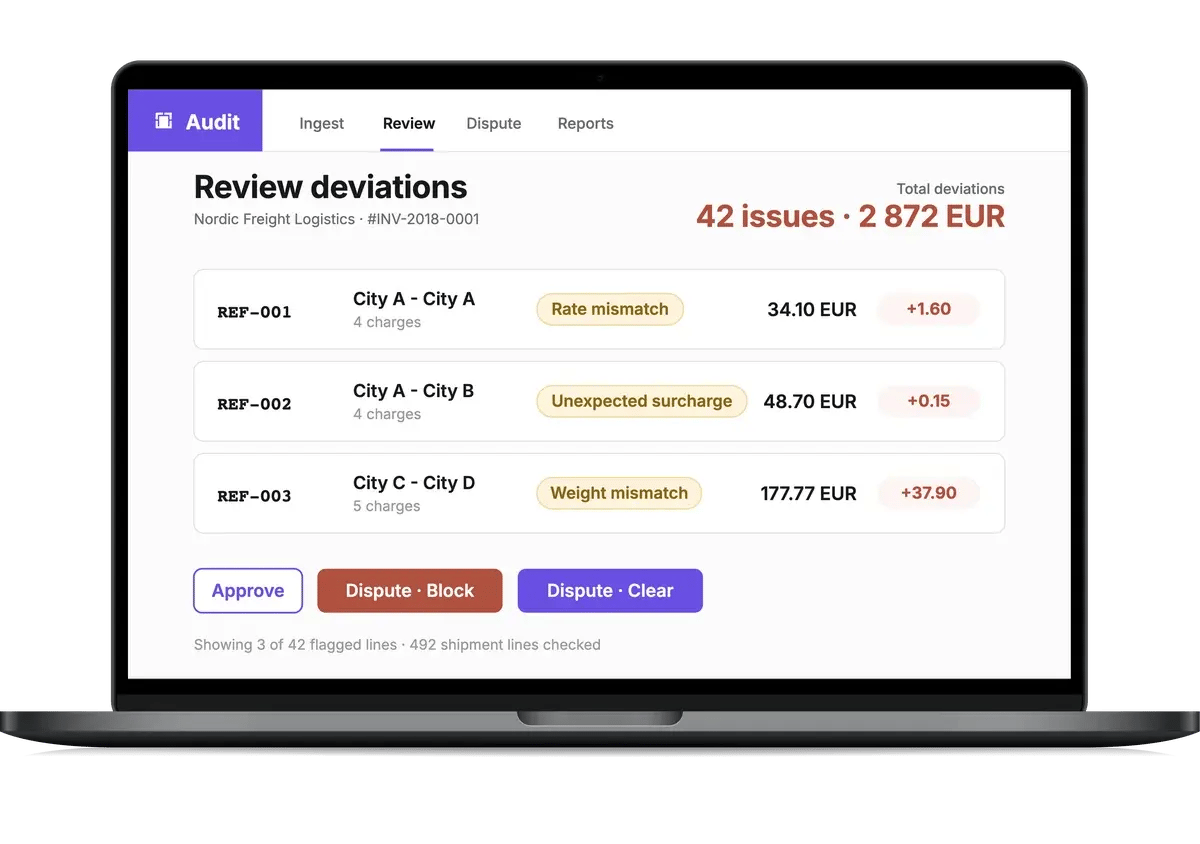
    nShift Audit screen: review deviations on an invoice. Each flagged line shows its issue (rate mismatch, unexpected surcharge, weight mismatch), with options to approve, dispute and block, or dispute and clear. Example: 42 issues worth 2,872 EUR across 492 shipment lines checked.

    Frequently asked questions

    Dates, shipment volumes, returns timing and peak costs for Black Friday and peak season 2026, from nShift platform data and IMRG research for nShift.

    Talk to us about your peak →

    When is Black Friday 2026?

    Black Friday 2026 falls on Friday 27 November. Cyber Monday is Monday 30 November, and Black Week runs from Monday 23 to Sunday 29 November.

    How much do shipments rise on Black Friday?

    Black Friday shipments run at about twice a normal Friday. Across nShift's platform, they ran 105% above a typical Friday in 2021 and 98% above an average Friday in 2024. In 2025, Black Friday carried more than twice the shipments of an early-November Friday.

    The rise varies by market: in Black Week 2025 it ranged from 44% above an average week for shipments from Finland to 112% for the UK.

    Read the Nordic peak analysis →

    Which is busier, Black Friday or Cyber Monday?

    Cyber Monday. Across nShift's platform, Cyber Monday carried about 8% more shipments than Black Friday in 2025.

    Part of that difference comes from the day of the week: Mondays carry more volume than Fridays throughout the year. Measured against its own weekday, Black Friday showed the sharper uplift in 2024, running 98% above an average Friday compared with 57% for Cyber Monday above an average Monday.

    How long does peak shipping season last?

    About five weeks. On nShift's platform in 2025, the peak ran from 17 November to 21 December, and 60% of the shipments above an average early-November week went out before or after Black Week.

    When should retailers start preparing for peak delivery?

    Start with the decision that has the longest lead time.

    Carrier capacity, integrations and major checkout changes may need months. Delivery messaging, returns rules and invoice-checking processes can often be adjusted closer to a campaign.

    Your own promotions may also create a peak before Black Friday arrives.

    Test your carrier resilience →

    What do customers complain about during peak delivery?

    Delays, missing notifications and pickup points they had not expected. Across 115,000+ Nordic delivery ratings from December 2025, most ratings were positive, but the average score slipped as the month went on, and negative comments clustered around those three issues.

    Read what 115,000 delivery ratings show →

    When do peak-season returns arrive?

    Returns build throughout the season and continue after Christmas.

    In nShift's 2024 data, returns peaked on 27 December at 49% above an average Friday, similar to previous years.

    Plan for January returns →

    When do shoppers think a return charge is fair?

    In specific cases. In IMRG research for nShift (1,000 UK shoppers, April 2026), 47.6% said a charge is fair for customers who return often, 26.2% for international orders and 25.8% for non-faulty items. Sale and discounted items ranked lowest of the four at 14.8%, and 21.5% said a return charge is never fair.

    Get the IMRG report →

    Can an exchange save a Black Friday sale?

    It can. In IMRG research for nShift, 66.1% of UK shoppers said they would likely take an easy exchange instead of a refund if one were offered, and fit was the return reason they cited most.

    Get the IMRG report →

    Why check carrier invoices after peak season?

    Peak volume produces peak invoices, and they arrive weeks after the peak. Published freight audit benchmarks put recoverable overcharges at 3 to 7% of freight spend, so match invoice lines to what actually shipped before you pay.

    Get the freight invoice guide →

    Bring us your hardest week of the year


    Tell us which campaign puts the most pressure on your delivery operation, and where its cost appears: carriers, checkout, returns or the invoice. We’ll show you where the pressure is building, what you can change and where nShift can make a measurable difference.

    Book a demo built around your own peak