
The value of a carrier contract depends on what happens after signature. The agreed rate card has to be applied at booking, surcharges checked at invoicing, and actual performance brought into the next renewal. Otherwise, part of the projected saving can disappear between procurement and daily shipping.
This guide covers the full carrier contract management lifecycle for retailers and ecommerce businesses shipping parcels across several carriers: what belongs in the contract, how to negotiate from your own shipping data, how to apply agreed terms in the systems that book shipments, how to verify invoices, and how to prepare for renewal.
What is carrier contract management?
Carrier contract management is the ongoing work of negotiating, implementing, and enforcing agreements with parcel and freight carriers. It covers rate negotiation, surcharge terms, contracted prices in shipping systems, invoice checks against agreed rates, and renewal or re-tendering based on performance evidence.
It sits within the wider discipline of carrier management, which also covers carrier selection, onboarding, performance, and the day-to-day relationship. Contract management focuses on the commercial terms: what you pay, which services and conditions apply, and what the carrier has committed to provide.
Treating the contract as an operating document keeps those terms connected to daily shipping. Agreed prices are applied when shipments are booked, invoices are checked against them, and the resulting data feeds the next negotiation.
What a carrier contract actually contains
The headline discount gets attention in negotiation, but the final cost per parcel depends on details across the agreement.
Base rates and rate cards. The core price grid is usually structured by service, weight break, and destination zone. Cross-border volumes may have different cards by lane. Currency, dimensional-weight rules, and zone definitions can all change what a "40 percent discount" is worth in practice. Dimensional weight deserves particular attention: the divisor determines whether a light, bulky parcel is billed at actual or volumetric weight, so a small change can re-price entire product categories. If your assortment includes bulky goods, model the proposed divisor against your actual parcel dimensions before agreeing to it.
Volume tiers and commitments. Discounts are often tied to annual or quarterly volume thresholds. Check what happens when a tier is missed: some contracts re-rate the full period, while others move the account to a different band from that point onward. Base volume commitments on evidence rather than optimistic forecasts, especially where missing a tier changes the price of shipments already sent.
Accessorials and surcharges. Fuel surcharges, residential delivery fees, peak-season supplements, oversize handling, address corrections, and re-delivery charges can account for a substantial share of parcel spend, and they often change more frequently than base rates. If the base grid is fixed while surcharges remain open-ended, total shipping cost can still move significantly. Ask for caps, notice periods, and a defined surcharge list, and specify how new charges can be introduced.
Liability, claims, and terms of payment. Check damage and loss liability limits, claim windows, payment terms, and the process for disputing a charge. Claim windows can be short on parcel accounts, so the internal dispute process needs to fit within them.
Term, exit, and change clauses. Review contract length, notice periods, auto-renewal language, and the carrier's right to adjust rates during the term. General rate increases and surcharge changes are usually governed here, and the notice period determines how much time you have to respond.
What ecommerce businesses should add to the contract
For an online retailer, the carrier agreement also covers services that customers see directly. Those service commitments should be defined as carefully as the rate card.
- Delivery options and PUDO access. If lockers, pickup points, or evening delivery matter at checkout, name the services in the agreement along with coverage areas and per-service pricing. Clear contractual coverage makes those options easier to plan and cost through peak periods.
- Tracking data quality. Customer notifications depend on the carrier's event feed. Specify event completeness and timeliness alongside transit-time commitments, because a missing out-for-delivery event can generate support demand even when the parcel arrives on schedule.
- Returns services. Return labels, drop-off network access, and cross-border return routing have their own prices and service expectations. Negotiating them alongside outbound terms gives you a clearer view of total carrier cost and avoids adding a major service line mid-term.
- Peak capacity. Volume caps and peak surcharges affect both cost and available capacity during the busiest weeks. Agree them early enough to compare options and plan volume allocation before peak starts.
Once these terms are written into the agreement, they become operational commitments that ecommerce, logistics, customer service, and finance can plan around.
Negotiate with your own shipping data
The carrier has a detailed view of the volume it already handles for you. Go into the negotiation with the same level of detail across your full carrier mix.
Build the data pack before the conversation starts:
- Twelve to eighteen months of shipment-level history. One row per shipment, with carrier, service, lane, actual weight, and destination type. Skip the aggregation: totals by weight band hide where your volume sits, and a rate card tested against them can favor the wrong weight brackets. The unaggregated history is the baseline for testing every proposed rate card and the input for the modeled scenarios below.
- Your surcharge exposure. Record which accessorials you incurred, how often they appeared, and what they cost. A proposal can reduce the base rate while increasing the effect of surcharges, so compare the total cost against your own history.
- Seasonality and peak shape. Carriers price capacity risk. A clear view of your peak profile gives both sides a better basis for discussing capacity and peak-surcharge terms than an open-ended volume estimate.
- Modeled scenarios. Apply the proposed rate card to last year's actual shipments. This turns the discussion from headline discounts into a like-for-like cost comparison across the mix you really shipped.
A delivery management platform can reduce the work required to build that view by keeping shipment records from multiple carriers in a consistent format. Booking, label, and tracking data can then support the negotiation pack and be reused for the next renewal review.
The same data helps with a recurring sourcing decision: whether to concentrate a dense lane with one carrier for a stronger tier discount or split volume across carriers for resilience and negotiating flexibility. Model both options against the tier structures on the table, include the operational cost of disruption during peak, and make the decision lane by lane rather than imposing one rule across the network.
Your negotiating position also depends on how easily volume can move. If adding an alternative carrier takes months, that constraint is visible in the commercial discussion. If another carrier can be onboarded quickly, the competition for volume is more credible. When Bauhaus brought ship-from-store online through nShift, all carriers were configured within 48 hours. As their Logistics Development Manager put it: "What mattered to us was execution. Carriers needed to be connected fast, without turning delivery into a separate program."
Load your contracts into the systems that book shipments
Negotiated rates create value when they are reflected in the booking process. If the contract and the shipping system use different prices or rules, the gap may not appear until a spend review or invoice check.
In practice, the commercial terms need to be represented in the systems used to book shipments.
Configure contracted prices in the platform
Rate cards, fees, and fee conditions should be entered or uploaded into the system that books shipments so quotes and booking decisions use the agreed prices. In nShift Ship, price calculation can be configured from your contracted rates, with fees and conditional supplements defined alongside them and price data maintained through structured uploads.
Use booking rules to apply the commercial strategy
Shipping rules can allocate shipments across the services you have under contract using criteria such as lowest price among compliant options. Warehouse teams can then follow the configured booking flow instead of checking carrier rate cards manually for each parcel.
Keep carrier connections current
Carrier API changes, label updates, and service revisions can affect the booking process. Maintained carrier connectivity keeps those integrations current at platform level while your team focuses on the carrier relationship and commercial terms.
In ERP-led shipping setups, expected cost can also be calculated before the invoice arrives. The Transsmart Tariff Engine calculates shipment cost from your own carrier contracts inside the booking flow, giving finance a contract-based cost expectation for each shipment.
For freight-heavy setups on nShift TMS, the same cost expectation is built into booking. Automatic Price estimates the cost of a new booking from your carrier tariffs, so the carrier is chosen with the price on screen. Actual transport spend is then tracked against contracted rates, and a discrepancy shows up while the invoice is still open.
Embacollage, a Danish packaging business supporting more than 220 retail brands, manages freight through nShift Ship connected to Microsoft Dynamics 365 Business Central. It reports fewer manual freight steps, clearer shipping cost visibility, and better control of transport costs.
Check every invoice against what you agreed
Carrier invoices are where the agreed commercial terms can be checked against actual shipments, and the money involved is not marginal. Freight audit benchmarks put recoverable overcharges at 3 to 7% of freight spend, and the Journal of Commerce Freight Benchmark Study put average freight invoice inaccuracy at 20.8%, roughly one in five invoices.
In container shipping, Drewry's research found discrepancy levels of 2 to 5% for larger shippers on annual contracts, rising to as much as 30% in the spot market. The studies cover different segments and years, but both underline the value of systematic invoice verification.
3-7%
of freight spend recoverable through invoice audit
Freight audit market research, DataIntelo and MarketIntelo, 2026
20.8%
average freight invoice inaccuracy, roughly one in five invoices
Journal of Commerce Freight Benchmark Study, 2020
2-5% vs 30%
invoice discrepancies on annual contracts versus the spot market, in container shipping
Drewry, 2018
Verification compares what the carrier billed with both the contract and the shipment record. For each invoice line, match:
- The contracted rate for that service, weight, and lane, including applicable surcharges.
- The shipment record: what was booked, what it weighed, and which service was used.
- The invoice line submitted by the carrier.
If the records agree, the charge can be approved. If they differ because of a re-weighed parcel, an unagreed surcharge, or a service substitution billed at a higher rate, the dispute should include the relevant shipment and contract evidence. Our freight invoice audit checklist covers what you need before the first invoice for a new contract arrives: the rate card, shipment records, and delivery events.
Manage disputes as a defined process. Log the invoice line, contractual basis, submission deadline, and outcome, then track the case through to credit or written resolution. Track recovery value and deviation patterns by carrier as well. Those figures show the financial effect of invoice checking and provide useful evidence for the next carrier review.
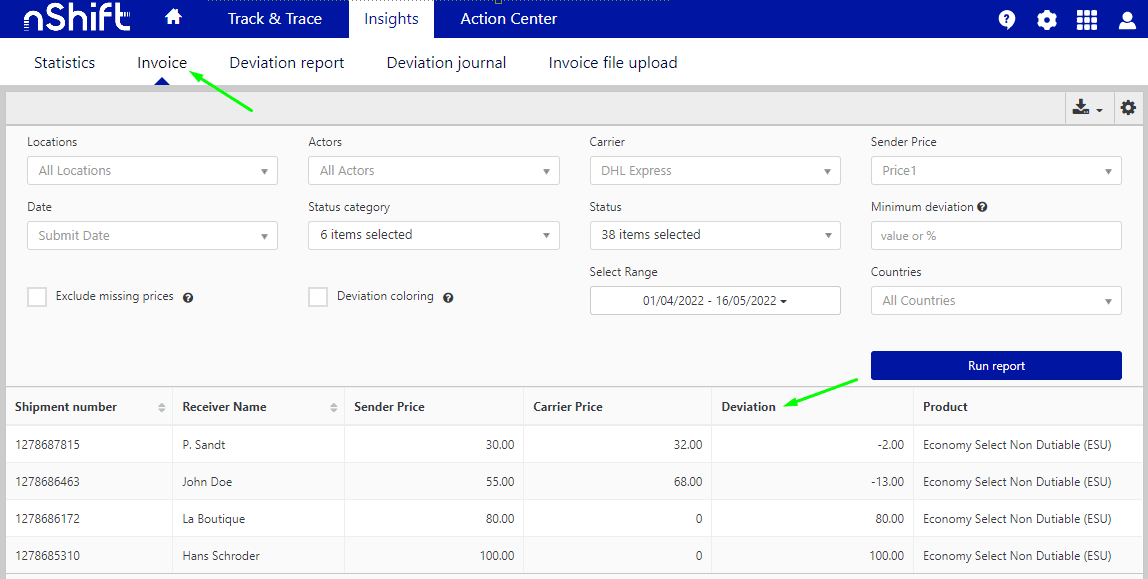
If you ship through nShift, the basic version of this check already exists in nShift Track. Insights compares the sender price from your rate calculation with the carrier's price, taken from carrier return data or from an invoice file you upload per carrier, and shows the difference per shipment. Deviations land in a journal where you verify or correct them, then in a report you can export for the dispute. This works when carrier data is clean or arrives in the file format Track expects; some of the features depend on your subscription. Past that point, invoices arrive in each carrier's own format, and the dispute is yours to run.
At thousands of shipments a month, manual line-by-line checking across different carrier formats becomes expensive and slow. nShift Audit, launching soon, reads freight and parcel invoices in raw carrier formats and checks every invoice line against the contracted rate and the shipment record already held in the platform: what was booked, what it weighed, which service was used, and whether it delivered. Deviations can be turned into evidence-backed disputes, sent to the carrier, and tracked to resolution, so teams recover the difference and approve invoices against verified shipment and contract data without adding headcount.
Carrier contract management also includes the service commitments in the agreement. Holding carriers to those terms requires measured delivery performance. Our guide to carrier performance measurement covers on-time rates, scorecards, and the evidence used in service reviews.
Renew on evidence, not inertia
Auto-renewal can preserve rates and surcharge terms that no longer match your current volumes or carrier mix. A disciplined renewal process starts early enough to review the evidence and compare alternatives before the notice deadline.
- Work backward from the notice period. If the contract requires 90 days' notice, start the internal review at least five months out. That leaves time to pull the data, model alternatives, and negotiate before the deadline becomes the main constraint.
- Bring the year's evidence. Compare actual volumes with committed tiers, review surcharge incidence, invoice deviations, and delivery performance, and use the findings in the renewal discussion.
- Choose re-tendering or renegotiation based on the data. Renegotiating with the incumbent reduces operational change, while re-tendering tests the current market price. The right route depends on the pricing gap you can evidence and how quickly an alternative carrier can become operational.
- Keep a connected alternative. A second or third carrier already carrying volume gives you a practical switching option. With a carrier network of over 1,000 carriers integrated at platform level, a newly contracted alternative can be configured without building a new carrier connection from scratch.
A multi-carrier setup also gives operations more options when a carrier faces a strike, capacity constraint, or sudden commercial change. Existing volume can be reallocated through the booking rules rather than requiring a new shipping setup under pressure.
"Carriers needed to be connected fast, without turning delivery into a separate program."
Logistics Development Manager, Bauhaus
All carriers configured within 48 hours of bringing ship-from-store online
What to expect from carrier contract management software
Dedicated contract lifecycle tools can store documents, track renewal dates, and manage clause libraries. Those functions are valuable, particularly for legal and procurement teams. Shipping operations also need to know whether the delivery platform can apply the contract in daily execution: use contracted rates at booking, enforce routing rules, predict shipment cost, maintain carrier connections, and retain the shipment data needed for invoice verification and renewals.
When evaluating carrier contract management software, check how directly it connects commercial terms to shipment execution. Multi-carrier shipping software can use contracted rates in booking decisions, preserve the shipment record for invoice checks, and give procurement and logistics a consistent dataset for the next negotiation.