The Competition and Markets Authority (CMA) wrote to online retailers on 2 November 2026 with its position in one line: "The first price consumers see should be the price they pay." Its open letter, timed for the Christmas shopping period, asks retailers to review their website, app and advertising so that every price shown includes the delivery fee a customer cannot avoid.
Drip pricing means showing part of a price upfront and adding unavoidable fees later in the purchase. Since 6 April 2025, UK law has required any price shown to consumers to be the total price, including mandatory delivery charges, at every stage from the first advert to payment. Optional delivery charges, such as a premium next-day upgrade, must still appear, but can be shown separately from the total.
CMA209, the CMA's price transparency guidance, sets out how to price one delivery fee across a whole basket, free delivery from a spend threshold, and a charge that changes by postcode.
What the drip pricing rules require
The drip pricing rules are set out in section 230 of the Digital Markets, Competition and Consumers Act 2024 (DMCC Act). They make the total price part of the information a consumer must receive whenever a price is shown: every fee, tax and charge the consumer has to pay, including delivery, booking and service charges.
The CMA's term for a price shown to a consumer is an "invitation to purchase". It covers product listings, baskets, marketing emails, social posts and online adverts. According to the CMA's price transparency guidance (CMA209), an invitation to purchase can exist "before it is possible to make a purchase", so a banner ad that names a price counts as much as the checkout page does.
The same Act lets the CMA fine businesses directly for consumer-law breaches, up to 10% of global turnover, without first going to court. In its letter, the CMA says it has already enforced the drip pricing rules against four businesses, with fines of more than £5.1 million and more than £1.35 million in refunds to consumers.
4 businesses
have faced CMA enforcement under the drip pricing rules
£5.1m+
in fines across those cases
£1.35m+
refunded to affected consumers
CMA open letter to online retailers, 2 November 2026
Shoppers notice hidden costs too. In Baymard Institute's checkout research among US online shoppers, 40% of those who abandoned a purchase blamed extra costs such as shipping, taxes and fees, and 12% said they could not see or calculate the total order cost upfront. Both figures exclude shoppers who were only browsing.
Our guide to UK returns policy rules explains how the same enforcement powers apply to returns information.
What the CMA's November 2026 letter asks online retailers to do
The CMA's letter states the delivery rule directly: where a customer must pay for delivery, "the total price including the minimum mandatory delivery charge must be shown to the customer throughout the sales process", which covers advertising, product pages, baskets, checkout and payment pages. The rule also applies to online marketplaces, comparison sites and search engines that display retailers' prices.
The letter lists four practices the CMA is looking out for:
- a product price shown without the mandatory delivery charge in the total
- basket totals or order summaries that leave out applicable mandatory delivery charges
- optional delivery fees hidden behind links, separate pages, pop-outs, expandable sections or drop-down menus
- delivery charges that first appear late in checkout
Retailers can still show a breakdown next to the total. The CMA gives the example of displaying the price of a product both including and excluding delivery. It also points retailers to paragraphs 5.2 to 5.21 of CMA209, which work through delivery cases with illustrated examples.
Does a delivery charge belong in the total price?
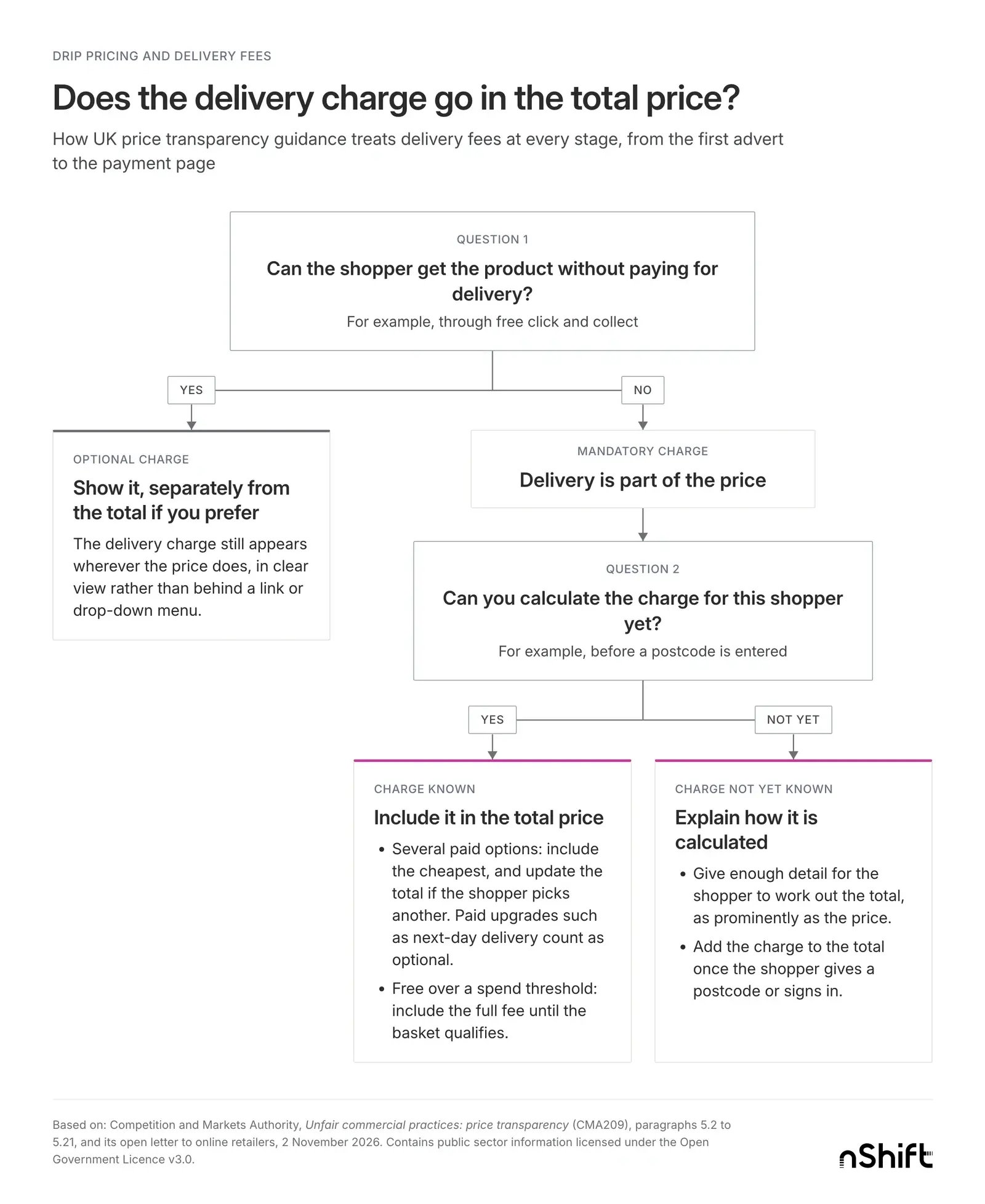
A delivery charge belongs in the total price when the customer cannot buy the product without paying it. CMA209 calls this a mandatory charge. A charge is optional when the customer can get the product without paying for delivery, for example through free collection. Premium upgrades, such as next-day or nominated-day delivery, also count as optional.
How each charge is shown depends on that split:
- Optional charges are still disclosed. They must appear in the invitation to purchase, but they can be shown separately from the total (CMA209, paragraphs 5.8 and 5.9).
- A choice of paid services keeps delivery mandatory. If every delivery option costs money, offering standard and next-day delivery does not make the charge optional. The total shown at the outset includes the cheapest delivery option, and it updates if the customer picks a more expensive one (paragraph 5.10).
Whether a charge counts as mandatory or optional can also depend on how the product is marketed. Free click and collect makes paid home delivery optional only when shoppers can choose collection for that product.
How to show a single delivery charge across a whole basket
When one delivery charge applies to the whole order, CMA209 accepts that adding it to every product's headline price "may not be realistic or meaningful", because the customer pays it once. Paragraph 5.17 sets out three ways to give the total price instead:
- show the total price, including delivery, below or alongside a headline price that excludes it
- show the base price and the delivery charge, plus a prominent running total that updates as products are added
- fold the delivery cost into product prices and offer free delivery
A running total has to stay in view and include the mandatory delivery charge. The guidance gives three designs that can work: a floating basket or sticky banner that follows the customer as they scroll, a dynamic "add to basket" button that shows what adding the item will cost including fees, and a basket that opens automatically after each product is added.
When the customer opens the basket, the total reflects what they have selected at that point, and if the delivery charge changes as they add or remove products, the total should update automatically (paragraph 5.20).
Free delivery thresholds and minimum spend offers
With a free-delivery threshold, the delivery fee stays in the price until the basket qualifies. CMA209 paragraph 5.14 uses the example of free delivery over £40: until the basket reaches £40, the total price includes the full delivery fee. Once the customer crosses the threshold, the total drops to reflect free delivery. You can tell customers along the way that the charge will be removed if the order goes over £40.
The banner that advertises the offer has its own rule. The Advertising Standards Authority (ASA) and the Committee of Advertising Practice (CAP) write and enforce the UK advertising codes. Their advice on delivery charges says a minimum spend for free delivery must be "explicitly clear in the headline claim", so a banner reads "Free delivery on orders over £40" rather than "Free delivery" with the condition further down. If the offer excludes some postcodes, the headline has to say that too.
The same advice covers delivery subscriptions: when customers pay upfront for unlimited delivery over a year, those deliveries should not be described as free.
Our guide to setting up free delivery covers how to choose the threshold itself.
Delivery charges that vary by postcode
A delivery charge that depends on the customer's address is often impossible to calculate before the customer says where they live. CMA209 separates what to show before the customer gives an address from what to show after. Until the charge can be calculated, you must say that delivery charges apply and explain how they are worked out (paragraph 5.12). That explanation needs enough detail for customers to calculate the total themselves, and the same prominence as the price you can show. Once the customer gives a postcode or signs in, the charge must go into the total at every step that follows (paragraph 5.13).
One example in CMA209 is a department store with five delivery zones: free seven-day delivery to mainland Great Britain, £5 to Northern Ireland, £10 to the Isle of Man, £15 to the Channel Islands, and £10 to the Scottish Highlands and Islands. The charges appear prominently on the product page. When the customer signs in with a saved address, the applicable charge appears in a visible running total.
If a mandatory charge varies "depending on factors outside the consumer's knowledge and control" and the retailer cannot calculate an inclusive total, the guidance calls it "not permissible", because the customer cannot calculate the total either.
Business Companion's guidance on delivery charges, published for businesses by the trading standards service, adds a point on place names: shoppers may read "UK delivery" as including the whole of Scotland, Northern Ireland and the islands. There is also no single definition of "Highlands and Islands", so list the areas a surcharge covers, for example by postcode.
A delivery pricing check before peak trading
Before the first promotion goes live, walk through your own site and check that the customer can see the price they will pay at every step.
Shop your own site like a customer
- Start where the customer starts. Check the price in a paid social ad, a marketing email and a product listing.
- Test the threshold. Build baskets below, at and above the free-delivery spend.
- Test the unusual postcodes. Compare a mainland, a Northern Ireland and a Highlands postcode at every step.
- Check the default. If every option is paid, the first total includes the cheapest one.
- Read the promotion headlines. Every "free delivery" claim shows its minimum spend and any postcode exclusions.
Check the prices you send to marketplaces and comparison sites as well, since the same rule applies to them. If a shopper could see one delivery price on the product page and another at checkout, look for separate copies of the delivery rules.
Keep delivery prices consistent from product page to checkout with nShift Checkout
nShift Checkout lets retailers set which delivery options appear, and at what price, from rules based on the customer's postcode, the basket value and the parcel weight. A free-delivery threshold, a Highlands surcharge and a next-day upgrade are all configured once, in one place.
The Product Page Widget shows those delivery options on the product detail page, where shoppers can preview and select delivery before they reach the checkout. Because the widget and the checkout use the same configuration, a rule change applies in both places.
Clear delivery choices at checkout also support conversion. Scandinavian Luxury Group, which uses nShift Checkout together with the payment provider Qliro, reports a 20% drop in cart abandonment and a 28% increase in order value. In the company's words: "The speed and simplicity offered by nShift and Qliro help us improve our conversion rate while also providing better options to our customers."
Your ecommerce platform displays the basket total, and the delivery price in it comes from the rules you set in nShift Checkout.