nShift vs Centiro:
Which delivery management platform fits your operation?

Compare how nShift and Centiro cover shipping, TMS, carrier connectivity, checkout, tracking, returns, emissions, delivery data, AI, finance control, integrations, and customer experience.

Based on publicly available first-party product pages, developer documentation, support pages, and company updates from nShift and Centiro, last reviewed on June 24, 2026.

Carrier coverage
nShift vs Centiro

nShift documents 1,000+ carriers, 190+ countries, 70+ PUDO networks, and 1.2M+ PUDO locations, with ERP/WMS depth and ISO 14083 / EN 16258 / GLEC-aligned CO₂e reporting.

Centiro describes a carrier portfolio spanning modes, types, and geographies, and says its visible carrier list is a selected sample that is continuously added to and changed. The reviewed pages do not publish PUDO network, PUDO location, or country-coverage figures directly comparable to nShift’s published carrier metrics.

logo-millesima-us-blanc

“A driving force for our growth”

Millesima used nShift to quickly connect to carriers across Europe, avoiding the time and cost of setting up each carrier individually, and accelerating its expansion into new markets. 

Product suite coverage
nShift vs Centiro

nShift

Centiro

nShift

Centiro

Capability

Product architecture
nShift has a broad named product portfolio covering delivery management, shipping APIs, TMS, checkout, tracking, returns, emissions, scanning, and AI-supported delivery management. Its portfolio is structured around Delivery Management solutions and Experience Management & Sustainability.
Centiro organizes its offer around four main product areas: Delivery Management, Customer Experience, Finance & Control, and AI & Intelligence. Its platform structure is consolidated rather than built around many separately named products.
Delivery management
nShift includes nShift Delivery, nShift Ship, and nShift Transsmart. nShift Ship is an enterprise solution for centralized booking and labeling across 1,000+ carriers, while nShift Delivery is a self-signup delivery solution for centralized booking and labeling across multiple carriers.
Centiro Delivery Management covers delivery execution, carrier portfolio, carrier selection, consolidation, zone skip, and linehaul. It emphasizes real-time automation, end-to-end visibility, carrier choice, cost-effectiveness, and AI/data-driven decisioning.
Transport management
nShift TMS is a dedicated, named transport management product for complex freight across road, air, and sea. Teams can plan, book, and monitor movements across carriers and modes in one cloud platform, with a modular structure spanning planning, cost, collaboration, emissions, and reporting.
Centiro does not present a separately named TMS product in the same way as nShift TMS. It does, however, include TMS capability within its platform, describing support for parcel shipping, delivery management, carrier management, and TMS.
Shipping API and embedded delivery
nShift Go connects platforms to thousands of carrier services through a single API. It includes normalized updates, one event stream, real-time events, webhooks, and the ability to expose carrier services while keeping brand and checkout logic.
Centiro includes API and system integrations within Delivery Management and open APIs/data feeds within AI & Intelligence. The reviewed first-party pages do not present a directly equivalent named shipping API product to nShift Go.
Carrier connectivity
nShift connects you to 1,000+ carriers across 190+ countries through one platform, with 70+ PUDO networks and 1.2M+ pickup and drop-off locations. The same network powers booking, labeling, tracking, and checkout delivery options, so teams can extend carriers and markets from one platform. Coverage figures are published and maintained on nShift’s carrier connectivity page.
Centiro describes a carrier portfolio spanning modes, types, and geographies across first mile, cross-border, and final mile. Its Carrier Portfolio page says the visible carrier list is a selected sample, with carriers continuously added and changed. It does not publish PUDO network, PUDO location, or country-coverage figures directly comparable to nShift’s published carrier metrics.
Checkout
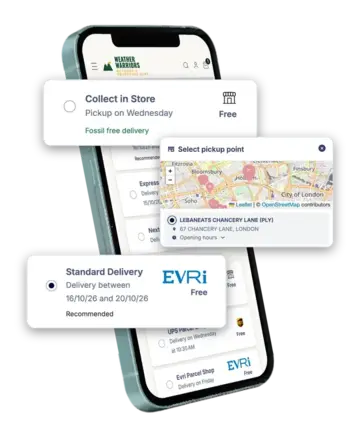
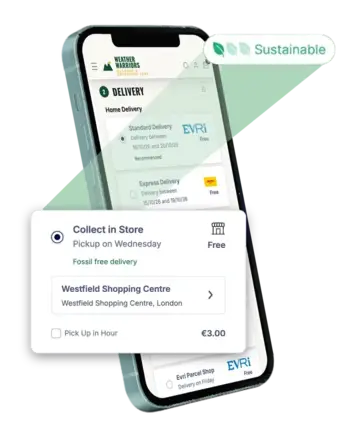
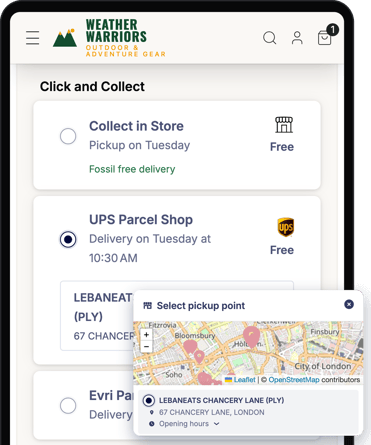
nShift Checkout presents delivery choices at the product page and basket: home delivery, pickup points, lockers, and express, each with prices and delivery times. Teams set rules by market, location, cart, product, carrier, availability, and price, run A/B tests, and apply AI-powered delivery intelligence. It integrates via Shopify, API, widgets, Kustom Checkout, and book-and-print.
Centiro Customer Experience includes checkout as part of its customer journey offer, alongside tracking, returns, and Control Tower. It supports delivery choices at checkout, tracking, fewer WISMO contacts, issue prediction, visibility, control, and returns.
Tracking and notifications
nShift Track provides proactive multi-channel updates, branded tracking pages, delivery-stage updates, promotional content or product recommendations inside update emails, non-event alerts for stalled or delayed parcels, and a central view that can support customer-service teams.
Centiro Customer Experience includes tracking and Control Tower. It supports full tracking, fewer WISMO contacts, issue prediction before problems happen, visibility, control, and returns.
Returns
nShift Returns supports a branded returns portal and URL, market-specific language and currency, content management for instructions, policies and visuals, an admin portal for regional settings, and customer-facing self-service returns functions.
Centiro presents returns inside its Customer Experience area, including branded self-service returns, multiple return options, automated return labels, and tracking. Its public page gives less standalone product-detail depth than nShift’s dedicated Returns product page.
AI and intelligence
nShift Companion is an AI-powered delivery management assistant that helps ecommerce teams understand delivery setup, surface better options, and suggest improvements using natural language. It is grounded in delivery data, business rules, and operational safeguards. nShift Checkout also includes nShift ETA for AI-predicted delivery times based on billions of historic shipments across 1,000+ carriers.
Centiro AI & Intelligence uses machine learning and predictive analytics to forecast delivery delays, recommend carriers, detect anomalies, learn from data, predict future outcomes, identify trends, and support analytics.
Delivery data layer
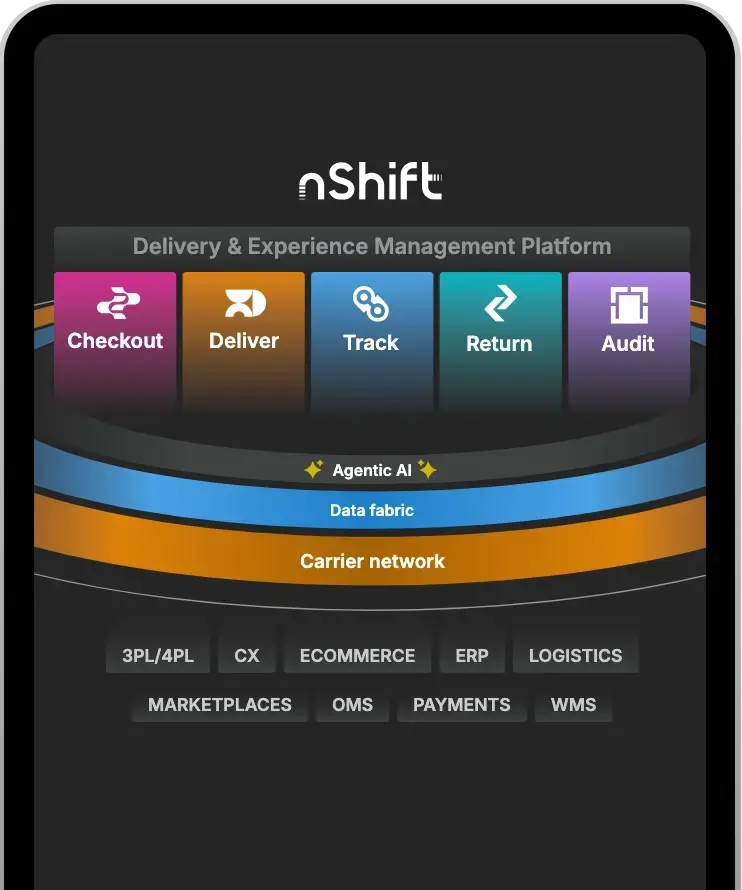
nShift Data Fabric is a unified data layer for connecting delivery systems, normalizing carrier feeds, and powering real-time visibility across the delivery journey. It brings in data from checkout, ERP, WMS, and carrier APIs, then normalizes events into consistent milestones and status codes.
Centiro does not present a named “data fabric” layer on the reviewed first-party pages. Its AI & Intelligence area covers analytics, predictive modeling, machine learning, simulation, and data-driven decisioning across logistics workflows.
Emissions and sustainability
nShift Sustainability Reporting automates shipment-level CO₂e aligned to ISO 14083, EN 16258, and the GLEC Framework, using NTM emission factors, with its calculation methodology certified by Smart Freight Centre (SFC). It also supports audit-ready outputs, CSV/Excel export, API/BI feeds, external data import, visible methods, and audit trails.
Centiro’s Delivery Management offer includes measurement, reporting, and optimization of carbon footprints and GHG emissions, while its company-level sustainability page cites UN Global Compact membership, ISO 14001 and ISO 50001 certification, EcoVadis Gold, LEED Gold-certified buildings, and cloud operations running on 100% renewable energy.
Finance and control
nShift handles cost and financial control through TMS, with a dedicated Cost module for freight cost management alongside Core, Collaborate, Emissions, and Report. Teams get freight planning, cost visibility, performance reporting, and emissions tracking in one modular platform, rather than a separately branded finance suite.
Centiro has an explicit dedicated public Finance & Control product area. It includes invoice audit, self billing, freight cost, billing proposal, billing-error detection, overbilling detection, duplicate-payment detection, contract alignment, refund support, margin control, and freight calculation.
Integrations
nShift publishes an integration ecosystem across ecommerce platforms, ERP, warehouse management systems, TMS, payment solution providers, marketplace platforms, APIs, and developer resources. Its product structure connects systems, carriers, and customers across delivery operations and experience management.
Centiro Delivery Management integrates with WMS, OMS, ERPs, ecommerce platforms, and more. Its AI & Intelligence area includes open APIs and data feeds for ERP and BI tools.
1064-hunkemoller-white

“We’ve made returns part of a seamless omnichannel”

nShift helped Hunkemöller transform returns, offering more convenience, choice, and communication, driving loyalty while protecting revenue. The results?  +15% shift to in-store returns. 

Key differentiators
nShift vs Centiro

Both nShift and Centiro address complex delivery operations, but they package the problem differently. nShift presents one connected platform across the full delivery journey, organized as named products you can adopt individually and extend over time. Centiro presents its offer more as one consolidated control platform, with a focus on finance control and predictive logistics.

Information is based on publicly available first-party sources from nShift and Centiro, last reviewed on June 24, 2026. All brand names are trademarks of their respective owners.

nShift

One connected platform, adopted one step at a time across the delivery journey

nShift presents one connected platform with a named product portfolio across delivery, TMS, API infrastructure, checkout, tracking, returns, emissions reporting, scanning, delivery data, and AI-supported delivery management, unified by shared delivery data. This supports a modular buying motion. A business can start with a specific operational problem, such as checkout delivery choice, multi-carrier shipping, transport management, returns, emissions reporting, or tracking, and then extend across the wider delivery journey.

Centiro

One connected control platform, centered on finance control and predictive logistics

Centiro presents a consolidated platform organized around delivery management, customer experience, finance and control, and AI and intelligence. This supports a platform-control buying motion. A business looking for delivery execution, carrier selection, finance control, predictive analytics, operational visibility, and customer-experience capabilities in one consolidated model may find that architecture familiar.

stenstroms-logo-400x200-white

“What makes nShift an ideal partner is that, as we grow, nShift will grow with us.”

By working with nShift, Stenströms has transformed the online shopping experience and increased revenue in major markets such as Germany, Canada and UK. Overall, Stenströms has increased international shipments by 153%.

Why brands choose nShift

28%

increase in order value

topformula-logo-200x400

1M

shipments per year
handled 95% faster

fbox-400x200

5M

shipments handled per year

elgiganten-logo-400x200

1,000

hours per year saved with automation

stihl-400x200

40%

more efficient picking process

jysk-400x200

Comparison at a glance

Both nShift and Centiro address complex delivery operations. The main difference is how each company structures its platform.
Checkout-badges-no-2
Checkout-badges-no-3
Checkout-badges-no-4
Checkout-badges-no-5

nShift

nShift presents a broad named product portfolio across operational delivery management, experience management, sustainability, delivery data, and AI-supported delivery management. Its public product pages list nShift Delivery, nShift Go, nShift Ship, nShift TMS, nShift Transsmart, Webshipper, nShift Checkout, nShift Companion, nShift Emissions Tracker, nShift Returns, nShift Scan App, and nShift Track. The same product structure presents the nShift platform as a connected foundation for delivery and experience management, supported by unified delivery data and a large carrier network.

Centiro

Centiro presents one consolidated platform organized around four main product areas, Delivery Management, Customer Experience, Finance & Control, and AI & Intelligence. Its public product pages describe a platform for parcel shipping, TMS, carrier management, delivery management, customer experience, finance control, and AI-powered logistics.

iciw-logo-400x200-inverted

“A game-changer in terms of handling enquiries relating to orders”

Since adopting nShift Track, ICIW cut unbranded emails, reduced delivery queries by 50%, and now saves about €12,000 annually in customer service costs.

1,000+ carriers ready for you

ups-logo-400
gls-logo-400
DHL-logo-vector
postnord-logo-400
dpd-logo-400
db-schenker-logo-400
fedex-logo-400
instabox-logo-400
budbee-logo-400

Where each fits

The practical difference is where the buyer’s delivery problem begins.
icon-check-pink

Choose nShift

nShift is easiest to understand when the buyer wants to improve a specific part of the delivery journey first, then expand from there. Common starting points include checkout delivery options, multi-carrier shipping, transport management, returns, tracking, emissions reporting, delivery data, AI assistance, and carrier connectivity across markets.

icon-centiro-coral

Choose Centiro

Centiro presents a more consolidated delivery-control model. Its positioning brings delivery execution, carrier selection, customer experience, freight cost, invoice audit, billing accuracy, Control Tower visibility, and predictive logistics into one platform story.

superdry-logo-400x200-inverted

“nShift is the right fit for our business”

nShift helps Superdry onboard carriers faster in new markets and gain full track-and-trace visibility across its network.

FAQs

How do nShift and Centiro differ?

nShift presents a broader named product portfolio across delivery management, TMS, shipping APIs, checkout, tracking, returns, emissions reporting, scanning, delivery data, and AI-supported delivery management. Centiro presents one consolidated platform organized around Delivery Management, Customer Experience, Finance & Control, and AI & Intelligence.

Which platform publishes more detailed carrier coverage metrics?

nShift publishes 1,000+ carriers, 190+ countries, 70+ PUDO networks, and 1.2M+ PUDO locations. Centiro describes a carrier portfolio spanning modes, types, and geographies and says its visible carrier list is a selected sample. The reviewed pages do not publish PUDO network, PUDO location, or country-coverage figures directly comparable to nShift’s published carrier metrics.

How do the finance-control positions differ?

Centiro has a dedicated Finance & Control product area covering invoice audit, self billing, freight cost, billing proposals, overbilling detection, duplicate-payment detection, contract alignment, refunds, and margin control. nShift also supports cost and reporting capabilities, especially through TMS.

How do the emissions and sustainability positions differ?

nShift publishes detailed shipment-level sustainability reporting, including CO₂e calculation aligned to ISO 14083, EN 16258, and the GLEC Framework, using NTM emission factors and audit-ready outputs. Its calculation methodology is certified by Smart Freight Centre (SFC). Centiro presents sustainability through product functionality and corporate commitments, including GHG measurement, reporting, and optimization, UN Global Compact membership, ISO 14001 and ISO 50001 certification, EcoVadis Gold, LEED Gold-certified buildings, and cloud operations running on 100% renewable energy.

How do the AI stories differ?

Both platforms have public AI messaging, but the emphasis differs. nShift focuses on AI-supported delivery management through Companion and AI-predicted delivery times through nShift ETA. Centiro focuses on predictive analytics and machine learning for forecasting delivery delays, recommending carriers, detecting anomalies, predicting outcomes, identifying trends, and supporting operational decision-making.

platform-tablet-cut

See nShift in action

platform-tablet-cut-7

Try our demo store

Customer stories

Understand how nShift helps businesses like yours

See how nShift stacks up - live, in your own workflow

Whether you're evaluating platform flexibility, carrier coverage, or customer experience, we’ll show you exactly how nShift delivers measurable results.

Sources

(last reviewed June 24, 2026)

This comparison is based on publicly available first-party product pages, developer documentation, support pages, and company updates from nShift and Centiro. All brand names are trademarks of their respective owners.

nShift product references:

nShift: Carrier connectivity (1,000+ carriers; 190+ countries; 70+ PUDO; 1.2M+ locations)

nShift: Checkout

nShift: Sustainability reporting (ISO 14083 / EN 16258 / GLEC alignment)

nShift: SFC certification (ISO 14083 / GLEC methodology)

nShift: Returns

nShift: Integration partners

Centiro figures are drawn from Centiro’s own first-party product, support, and company pages, reviewed on the date above.